Recognize the role of hydroxide ions: The OH^- ions increase the pH of the solution, making it basic.
Consider the implications: The complete dissociation of KOH in water results in a high concentration of OH^- ions, which is characteristic of strong bases.
Verified video answer for a similar problem:
This video solution was recommended by our tutors as helpful for the problem above.
Video duration:
2m
Play a video:
0 Comments
Key Concepts
Here are the essential concepts you must grasp in order to answer the question correctly.
Dissociation of Strong Bases
Strong bases, like potassium hydroxide (KOH), dissociate completely in water into their constituent ions. In the case of KOH, it separates into potassium ions (K+) and hydroxide ions (OH-). This complete dissociation is a key characteristic of strong bases, leading to a significant increase in the concentration of hydroxide ions in the solution.
Strong Acid Strong Base Titrations (Simplified) Concept 1
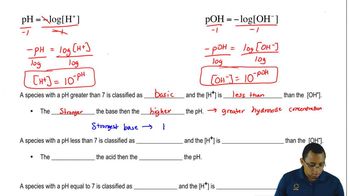
pH and Basicity
The pH scale measures the acidity or basicity of a solution, with values below 7 indicating acidity and values above 7 indicating basicity. When a strong base like KOH is dissolved in water, the concentration of hydroxide ions increases, resulting in a higher pH value, typically above 13. This indicates a strongly basic solution, which can have significant effects on chemical reactions and biological systems.
Neutralization reactions occur when an acid and a base react to form water and a salt. The hydroxide ions from the strong base KOH can react with hydrogen ions (H+) from an acid, effectively neutralizing the acid. Understanding this concept is crucial for predicting the outcomes of reactions involving strong bases and acids, as well as for applications in titration and buffer solutions.

 2:09 minutes
 Verified step by step guidance
 01:02
01:02