Which of the following solutions has the higher osmolarity?
0.30 M NaOH or 3.0% (m/v) NaOH
Verified step by step guidance
1
Convert the mass/volume percentage concentration of NaOH to molarity. Assume 100 mL of solution for simplicity, which means 3.0 g of NaOH is present.
Calculate the molar mass of NaOH by adding the atomic masses of sodium (Na), oxygen (O), and hydrogen (H).
Convert the mass of NaOH (3.0 g) to moles using the molar mass calculated in the previous step.
Determine the molarity of the 3.0% (m/v) NaOH solution by dividing the moles of NaOH by the volume of the solution in liters (0.1 L).
Compare the molarity of the 3.0% (m/v) NaOH solution with the given 0.30 M NaOH solution to determine which has the higher osmolarity.
Verified video answer for a similar problem:
This video solution was recommended by our tutors as helpful for the problem above.
Video duration:
8m
Play a video:
0 Comments
Key Concepts
Here are the essential concepts you must grasp in order to answer the question correctly.
Osmolarity
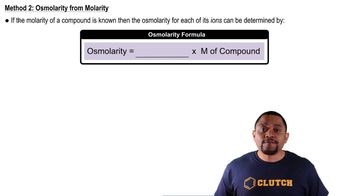
Osmolarity is a measure of the total concentration of solute particles in a solution. It is expressed in osmoles per liter (osmol/L) and takes into account all particles that contribute to the solution's osmotic pressure, including ions and molecules. For ionic compounds like NaOH, which dissociates into sodium (Na⁺) and hydroxide (OH⁻) ions, the osmolarity is calculated by multiplying the molarity by the number of particles produced upon dissociation.
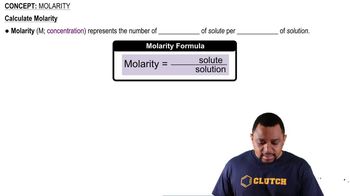
Molarity is a way to express the concentration of a solution, defined as the number of moles of solute per liter of solution (mol/L). In the case of NaOH, a 0.30 M solution means there are 0.30 moles of NaOH in one liter of solution. Understanding molarity is essential for calculating osmolarity, especially for ionic compounds that dissociate in solution.
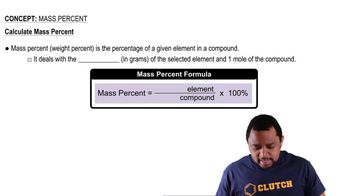
Mass/volume percent concentration (m/v) is a way to express the concentration of a solution as the mass of solute per 100 mL of solution. For example, a 3.0% (m/v) NaOH solution means there are 3 grams of NaOH in 100 mL of solution. To compare this with molarity, one must convert the mass of NaOH to moles and then calculate the molarity to determine the osmolarity.

 8:34 minutes
 Verified step by step guidance
 00:37
00:37