For chlorine, identify the group number, give the number of electrons in each occupied shell, and write its valence-shell configuration.
Verified step by step guidance
1
Identify the group number of chlorine in the periodic table. Chlorine is located in Group 17, which is also known as the halogens.
Determine the atomic number of chlorine, which is 17. This tells us that chlorine has 17 electrons.
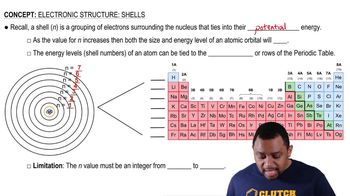
Distribute the 17 electrons into the appropriate electron shells. The first shell can hold up to 2 electrons, the second shell can hold up to 8 electrons, and the third shell can hold the remaining electrons.
Write the electron configuration for chlorine. Start filling the electrons from the lowest energy level to the highest: 1s, 2s, 2p, 3s, and 3p.
Identify the valence-shell configuration. The valence shell is the outermost shell, which for chlorine is the third shell. Write the configuration for the valence electrons.
Verified video answer for a similar problem:
This video solution was recommended by our tutors as helpful for the problem above.
Video duration:
6m
Play a video:
0 Comments
Key Concepts
Here are the essential concepts you must grasp in order to answer the question correctly.
Group Number
The group number in the periodic table indicates the number of valence electrons in the outermost shell of an element. Chlorine is located in Group 17 (or Group VIIA), which means it has seven valence electrons. This classification helps predict the element's chemical behavior and reactivity.
Electron shells are the regions around an atom's nucleus where electrons are likely to be found. For chlorine, which has an atomic number of 17, the electron configuration is 2 electrons in the first shell, 8 in the second, and 7 in the third. Understanding the distribution of electrons across these shells is crucial for grasping the atom's structure and bonding properties.
The valence-shell configuration refers to the arrangement of electrons in the outermost shell of an atom, which determines its chemical properties. For chlorine, the valence-shell configuration is 3s² 3p⁵, indicating that it has two electrons in the s subshell and five in the p subshell of the third energy level. This configuration is key to understanding how chlorine interacts with other elements.

 6:37 minutes
 Verified step by step guidance
 03:13
03:13