What happens when a weak acid such as CH₃CO₂H is dissolved in water?
Verified step by step guidance
1
Identify the weak acid: In this case, the weak acid is acetic acid, CH₃CO₂H.
Understand the concept of weak acids: Weak acids do not completely dissociate in water. Instead, they establish an equilibrium between the undissociated acid and the ions produced.
Write the chemical equation for the dissociation: CH₃CO₂H (aq) ⇌ CH₃CO₂⁻ (aq) + H⁺ (aq).
Recognize the equilibrium nature: Since acetic acid is a weak acid, the equilibrium lies to the left, meaning that most of the acetic acid remains undissociated in the solution.
Consider the implications: The presence of H⁺ ions in the solution makes it acidic, but the concentration of H⁺ ions is lower compared to a strong acid of the same concentration due to the partial dissociation.
Verified video answer for a similar problem:
This video solution was recommended by our tutors as helpful for the problem above.
Video duration:
2m
Play a video:
0 Comments
Key Concepts
Here are the essential concepts you must grasp in order to answer the question correctly.
Weak Acids
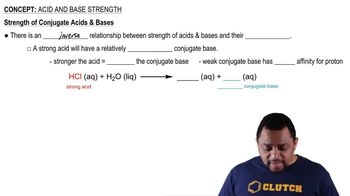
Weak acids, like acetic acid (CH₃CO₂H), do not completely dissociate in water. Instead, they establish an equilibrium between the undissociated acid and its ions. This partial ionization means that weak acids have a lower concentration of hydrogen ions compared to strong acids, which fully dissociate.
When a weak acid dissolves in water, it dissociates into hydrogen ions (H⁺) and conjugate base ions (A⁻). The process reaches a dynamic equilibrium, where the rate of dissociation equals the rate of recombination. This equilibrium is described by the acid dissociation constant (Ka), which quantifies the strength of the acid.
The pH of a solution is a measure of its acidity, determined by the concentration of hydrogen ions. Weak acids result in a higher pH compared to strong acids at the same concentration due to their incomplete dissociation. Understanding pH is crucial for predicting the behavior of weak acids in various chemical reactions and biological systems.

 2:59 minutes
 Verified step by step guidance
 00:42
00:42