Sketch an energy diagram for a system in which the forward reaction has E_act = +25 kcal/mol (+105 kJ/mol) and the reverse reaction has E_act = +35 kcal/mol (+146 kJ/mol).Is the forward process endergonic or exergonic?
Verified step by step guidance
1
Identify the activation energy (E_{act}) for both the forward and reverse reactions. The forward reaction has E_{act} = +25 \text{ kcal/mol} (+105 \text{ kJ/mol}), and the reverse reaction has E_{act} = +35 \text{ kcal/mol} (+146 \text{ kJ/mol}).
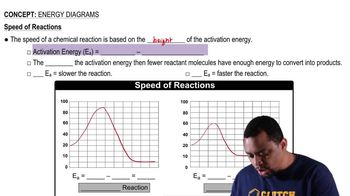
Understand that the activation energy is the energy barrier that must be overcome for a reaction to proceed. It is the difference in energy between the reactants and the transition state.
Sketch the energy diagram: Start by drawing a horizontal line to represent the energy level of the reactants. Then, draw a peak to represent the transition state, with the height of the peak above the reactants corresponding to the activation energy of the forward reaction (+25 kcal/mol).
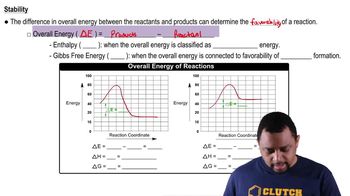
Draw another horizontal line to represent the energy level of the products. The difference in height between the reactants and products will indicate whether the reaction is endergonic or exergonic.
Determine if the forward process is endergonic or exergonic: If the energy level of the products is lower than that of the reactants, the reaction is exergonic (releases energy). If the energy level of the products is higher, the reaction is endergonic (absorbs energy).
Was this helpful?
Key Concepts
Here are the essential concepts you must grasp in order to answer the question correctly.
Activation Energy (E_act)
Activation energy is the minimum energy required for a chemical reaction to occur. It represents the energy barrier that reactants must overcome to transform into products. In this question, the forward reaction has an activation energy of +25 kcal/mol, while the reverse reaction has a higher activation energy of +35 kcal/mol, indicating that the forward reaction is less energetically demanding than the reverse.
Endergonic reactions absorb energy from their surroundings, resulting in a positive change in Gibbs free energy (ΔG > 0), while exergonic reactions release energy, leading to a negative change in Gibbs free energy (ΔG < 0). To determine whether the forward process is endergonic or exergonic, one must consider the relative energies of reactants and products, which can be inferred from the activation energies provided.
Gibbs free energy is a thermodynamic potential that measures the maximum reversible work obtainable from a thermodynamic system at constant temperature and pressure. The sign of ΔG indicates the spontaneity of a reaction: a negative ΔG suggests that the reaction can occur spontaneously (exergonic), while a positive ΔG indicates that the reaction is non-spontaneous (endergonic). Understanding ΔG is crucial for determining the nature of the forward reaction in this context.