Which reaction is faster, one with E_act = +10 kcal/mol(+41.8 kJ/mol) or one with E_act = +5 kcal/mol(+20.9 kJ/mol)? Explain.
Verified step by step guidance
1
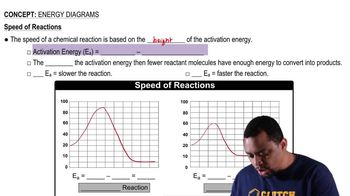
Understand that the rate of a chemical reaction is influenced by the activation energy (E_{act}), which is the minimum energy required for a reaction to occur.
Recognize that a lower activation energy generally means that a reaction will proceed faster because fewer energy barriers need to be overcome for the reactants to transform into products.
Compare the given activation energies: E_{act} = +10 \text{ kcal/mol} (+41.8 \text{ kJ/mol}) and E_{act} = +5 \text{ kcal/mol} (+20.9 \text{ kJ/mol}).
Identify that the reaction with E_{act} = +5 \text{ kcal/mol} (+20.9 \text{ kJ/mol}) has a lower activation energy compared to the reaction with E_{act} = +10 \text{ kcal/mol} (+41.8 \text{ kJ/mol}).
Conclude that the reaction with the lower activation energy (E_{act} = +5 \text{ kcal/mol}) is expected to be faster than the one with the higher activation energy (E_{act} = +10 \text{ kcal/mol}).
Was this helpful?
Key Concepts
Here are the essential concepts you must grasp in order to answer the question correctly.
Activation Energy (E_act)
Activation energy (E_act) is the minimum energy required for a chemical reaction to occur. It represents the energy barrier that reactants must overcome to transform into products. A lower activation energy indicates that a reaction can proceed more easily and quickly, as fewer energy collisions are needed to reach the transition state.
The reaction rate refers to the speed at which reactants are converted into products in a chemical reaction. It is influenced by several factors, including temperature, concentration, and the presence of catalysts. Generally, reactions with lower activation energies have higher rates because they require less energy to initiate.
The Arrhenius equation describes the relationship between the rate constant of a reaction and its activation energy, temperature, and a pre-exponential factor. It is expressed as k = A * e^(-E_act/RT), where k is the rate constant, A is the frequency factor, R is the gas constant, and T is the temperature in Kelvin. This equation illustrates that as activation energy decreases, the rate constant increases, leading to faster reactions.