A solution is prepared by bubbling 15.0 L of HCl(g) at 25 °C and 1 atm into 250.0 mL of water.Assuming all the HCl dissolves in the water, how many moles of HCl are in solution?
Verified step by step guidance
1
Identify the given values: 15.0 L of HCl gas, temperature = 25 °C, pressure = 1 atm, and volume of water = 250.0 mL.
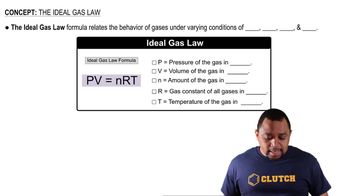
Use the Ideal Gas Law to find the number of moles of HCl gas. The Ideal Gas Law is given by the equation: PV = nRT, where P is pressure, V is volume, n is the number of moles, R is the ideal gas constant, and T is temperature in Kelvin.
Convert the temperature from Celsius to Kelvin by adding 273.15 to the Celsius temperature: T(K) = 25 + 273.15.
Use the ideal gas constant R = 0.0821 L·atm/mol·K. Substitute the known values into the Ideal Gas Law equation: (1 atm)(15.0 L) = n(0.0821 L·atm/mol·K)(T in Kelvin).
Solve for n, the number of moles of HCl, by rearranging the equation to n = PV / RT and substituting the known values.
Was this helpful?
Key Concepts
Here are the essential concepts you must grasp in order to answer the question correctly.
Ideal Gas Law
The Ideal Gas Law relates the pressure, volume, temperature, and number of moles of a gas through the equation PV = nRT. In this context, it allows us to calculate the number of moles of HCl gas by using the given volume (15.0 L), pressure (1 atm), and temperature (25 °C).
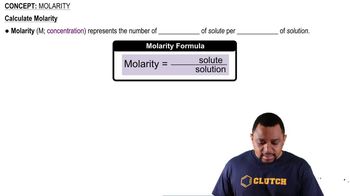
Molarity is a measure of concentration defined as the number of moles of solute per liter of solution. In this problem, understanding how to calculate the molarity of HCl in the final solution is essential for determining the concentration after the gas dissolves in 250.0 mL of water.
The dissolution of gases in liquids is influenced by factors such as temperature and pressure. In this scenario, the assumption that all HCl gas dissolves in water is crucial for calculating the total moles of HCl in solution, as it simplifies the process by eliminating any potential gas escape.