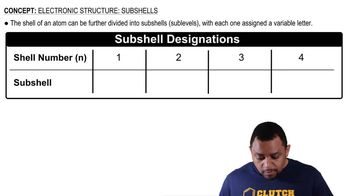
How many subshells are there in the third shell? The fourth shell? The fifth shell?
Verified step by step guidance
1
Identify the principal quantum number (n) for each shell: third shell (n=3), fourth shell (n=4), fifth shell (n=5).
Recall that the number of subshells in a shell is equal to the principal quantum number (n).
For the third shell (n=3), determine the number of subshells by using the formula: number of subshells = n.
For the fourth shell (n=4), apply the same formula to find the number of subshells.
For the fifth shell (n=5), use the formula again to determine the number of subshells.
Verified video answer for a similar problem:
This video solution was recommended by our tutors as helpful for the problem above.
Video duration:
2m
Play a video:
0 Comments
Key Concepts
Here are the essential concepts you must grasp in order to answer the question correctly.
Electron Shells
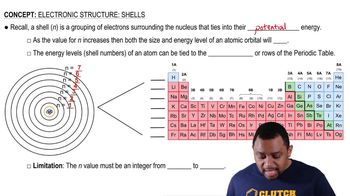
Electron shells are regions around an atom's nucleus where electrons are likely to be found. Each shell is designated by a principal quantum number (n), which indicates its energy level and distance from the nucleus. The first shell (n=1) can hold a maximum of 2 electrons, while subsequent shells can hold more, with the capacity increasing as n increases.
Subshells are subdivisions of electron shells and are defined by the angular momentum quantum number (l). Each shell can contain one or more subshells, which are designated as s, p, d, and f. The number of subshells in a shell corresponds to the value of n; for example, the third shell (n=3) has three subshells: 3s, 3p, and 3d.
Quantum numbers are sets of numerical values that describe the unique quantum state of an electron in an atom. The principal quantum number (n) indicates the shell, the angular momentum quantum number (l) indicates the subshell, and the magnetic quantum number (m_l) specifies the orientation of the subshell. Understanding these numbers is essential for determining the arrangement of electrons in an atom and the number of subshells in each shell.

 2:41 minutes
 Verified step by step guidance
 02:29
02:29