An ethylene glycol solution contains 25.2 g of ethylene glycol (C2H6O2) in 99.5 mL of water. Determine the change in boiling point. Assume a density of 1.00 g/mL for water.
Table of contents
- 1. The Chemical World9m
- 2. Measurement and Problem Solving2h 19m
- 3. Matter and Energy2h 15m
- Classification of Matter18m
- States of Matter8m
- Physical & Chemical Changes19m
- Chemical Properties8m
- Physical Properties5m
- Temperature (Simplified)9m
- Law of Conservation of Mass5m
- Nature of Energy5m
- First Law of Thermodynamics7m
- Endothermic & Exothermic Reactions7m
- Heat Capacity17m
- Thermal Equilibrium (Simplified)8m
- Intensive vs. Extensive Properties13m
- 4. Atoms and Elements2h 33m
- The Atom (Simplified)9m
- Subatomic Particles (Simplified)11m
- Isotopes17m
- Ions (Simplified)22m
- Atomic Mass (Simplified)17m
- Periodic Table: Element Symbols6m
- Periodic Table: Classifications11m
- Periodic Table: Group Names8m
- Periodic Table: Representative Elements & Transition Metals7m
- Periodic Table: Phases (Simplified)8m
- Periodic Table: Main Group Element Charges12m
- Atomic Theory9m
- Rutherford Gold Foil Experiment9m
- 5. Molecules and Compounds1h 50m
- Law of Definite Proportions9m
- Periodic Table: Elemental Forms (Simplified)6m
- Naming Monoatomic Cations6m
- Naming Monoatomic Anions5m
- Polyatomic Ions25m
- Naming Ionic Compounds11m
- Writing Formula Units of Ionic Compounds7m
- Naming Acids18m
- Naming Binary Molecular Compounds6m
- Molecular Models4m
- Calculating Molar Mass9m
- 6. Chemical Composition1h 23m
- 7. Chemical Reactions1h 43m
- 8. Quantities in Chemical Reactions1h 8m
- 9. Electrons in Atoms and the Periodic Table2h 32m
- Wavelength and Frequency (Simplified)5m
- Electromagnetic Spectrum (Simplified)11m
- Bohr Model (Simplified)9m
- Emission Spectrum (Simplified)3m
- Electronic Structure4m
- Electronic Structure: Shells5m
- Electronic Structure: Subshells4m
- Electronic Structure: Orbitals11m
- Electronic Structure: Electron Spin3m
- Electronic Structure: Number of Electrons4m
- The Electron Configuration (Simplified)20m
- The Electron Configuration: Condensed4m
- Ions and the Octet Rule9m
- Valence Electrons of Elements (Simplified)5m
- Periodic Trend: Metallic Character4m
- Periodic Trend: Atomic Radius (Simplified)7m
- Periodic Trend: Ionization Energy (Simplified)9m
- Periodic Trend: Electron Affinity (Simplified)7m
- Electron Arrangements5m
- The Electron Configuration: Exceptions (Simplified)12m
- 10. Chemical Bonding2h 10m
- Lewis Dot Symbols (Simplified)7m
- Ionic Bonding6m
- Covalent Bonds6m
- Lewis Dot Structures: Neutral Compounds (Simplified)8m
- Bonding Preferences6m
- Multiple Bonds4m
- Lewis Dot Structures: Multiple Bonds10m
- Lewis Dot Structures: Ions (Simplified)8m
- Lewis Dot Structures: Exceptions (Simplified)12m
- Resonance Structures (Simplified)5m
- Valence Shell Electron Pair Repulsion Theory (Simplified)4m
- Electron Geometry (Simplified)7m
- Molecular Geometry (Simplified)9m
- Bond Angles (Simplified)11m
- Dipole Moment (Simplified)14m
- Molecular Polarity (Simplified)7m
- 11 Gases2h 7m
- 12. Liquids, Solids, and Intermolecular Forces1h 11m
- 13. Solutions3h 1m
- 14. Acids and Bases2h 14m
- 15. Chemical Equilibrium1h 27m
- 16. Oxidation and Reduction1h 33m
- 17. Radioactivity and Nuclear Chemistry53m
13. Solutions
Boiling Point Elevation
Problem 21
Textbook Question
When 1.0 mol of HF is dissolved in 1.0 kg of water, the boiling point of the resulting solution is 100.5 °C. Is HF a strong or weak electrolyte? Explain.
Verified step by step guidance1
insert step 1: Understand the concept of electrolytes. Strong electrolytes completely dissociate into ions in solution, while weak electrolytes only partially dissociate.
insert step 2: Recall the colligative properties of solutions. The boiling point elevation is a colligative property, which depends on the number of solute particles in the solution.
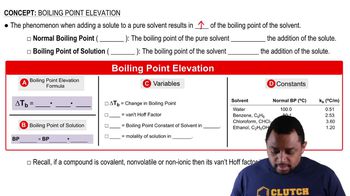
insert step 3: Use the boiling point elevation formula: \( \Delta T_b = i \cdot K_b \cdot m \), where \( \Delta T_b \) is the boiling point elevation, \( i \) is the van't Hoff factor, \( K_b \) is the ebullioscopic constant of the solvent, and \( m \) is the molality of the solution.
insert step 4: Calculate the boiling point elevation: \( \Delta T_b = 100.5 \degree C - 100.0 \degree C = 0.5 \degree C \).
insert step 5: Analyze the van't Hoff factor \( i \). If HF were a strong electrolyte, it would completely dissociate, resulting in a higher \( i \) value and a greater boiling point elevation. The observed \( \Delta T_b \) suggests partial dissociation, indicating HF is a weak electrolyte.
Was this helpful?
Key Concepts
Here are the essential concepts you must grasp in order to answer the question correctly.
Electrolytes
Electrolytes are substances that dissociate into ions when dissolved in water, allowing the solution to conduct electricity. They can be classified as strong or weak based on the extent of their ionization. Strong electrolytes completely dissociate into ions, while weak electrolytes only partially dissociate, resulting in fewer ions in solution.
Recommended video:
Guided course
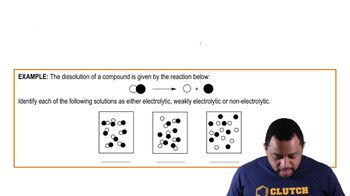
Electrolytes (Simplified) Example 3
Boiling Point Elevation
Boiling point elevation is a colligative property that describes how the boiling point of a solvent increases when a solute is added. The extent of this elevation depends on the number of solute particles in the solution. In this case, the increase in boiling point from 100 °C to 100.5 °C indicates that the solute (HF) contributes to the solution's overall particle concentration.
Recommended video:
Guided course
Boiling Point Elevation Concept 1
HF as an Electrolyte
Hydrofluoric acid (HF) is classified as a weak electrolyte because it only partially ionizes in solution. When HF dissolves in water, it produces a mixture of HF molecules and ions (H⁺ and F⁻), but not all HF molecules dissociate. The observed boiling point elevation suggests that HF does contribute to the solution's ionic strength, but its incomplete dissociation confirms its status as a weak electrolyte.
Recommended video:
Guided course
Electrolytes (Simplified) Example 3
Watch next
Master Boiling Point Elevation Concept 1 with a bite sized video explanation from Jules
Start learningRelated Videos
Related Practice
Multiple Choice