Complete each of the statements a to d using 1, 2, or 3:
1. decreases
2. increases
3. remains the same
Going from left to right across Period 4,
d. the number of valence electrons
Verified step by step guidance
1
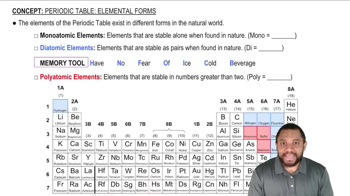
Identify the position of Period 4 in the periodic table, which starts with potassium (K) and ends with krypton (Kr).
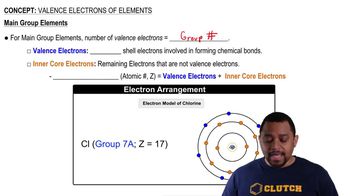
Recall that valence electrons are the electrons in the outermost shell of an atom.
Understand that as you move from left to right across a period in the periodic table, each element has one more proton and one more electron than the element before it.
Recognize that the additional electron is added to the same outer shell, increasing the number of valence electrons.
Conclude that the number of valence electrons increases as you move from left to right across Period 4.
Verified video answer for a similar problem:
This video solution was recommended by our tutors as helpful for the problem above.
Video duration:
2m
Play a video:
0 Comments
Key Concepts
Here are the essential concepts you must grasp in order to answer the question correctly.
Periodic Trends
Periodic trends refer to the predictable patterns observed in the properties of elements as you move across a period or down a group in the periodic table. These trends include atomic radius, ionization energy, electronegativity, and the number of valence electrons. Understanding these trends is essential for predicting how elements will behave in chemical reactions.
Valence electrons are the electrons in the outermost shell of an atom that are involved in forming chemical bonds. The number of valence electrons determines an element's reactivity and its ability to bond with other elements. In Period 4, elements gain valence electrons as you move from left to right, which influences their chemical properties.
Valence Electrons of Elements (Simplified) Concept 1
Period 4 Elements
Period 4 of the periodic table includes elements from potassium (K) to krypton (Kr). As you progress across this period, the atomic number increases, leading to an increase in the number of protons and electrons. This results in a corresponding increase in the number of valence electrons, which is crucial for understanding the chemical behavior of these elements.

 2:01 minutes
 Verified step by step guidance
 00:38
00:38