Use metric conversion factors to solve each of the following problems:b. A glass of orange juice contains 3.2 dL of juice. How many milliliters of orange juice are in the glass?
Verified step by step guidance
1
Identify the given quantity: 3.2 deciliters (dL) of orange juice.
Recall the conversion factor between deciliters and milliliters: 1 dL = 100 mL.
Set up the conversion by multiplying the given quantity by the conversion factor: 3.2 dL * (100 mL / 1 dL).
Cancel out the units of deciliters (dL) to convert to milliliters (mL).
Perform the multiplication to find the number of milliliters of orange juice.
Was this helpful?
Key Concepts
Here are the essential concepts you must grasp in order to answer the question correctly.
Metric Units
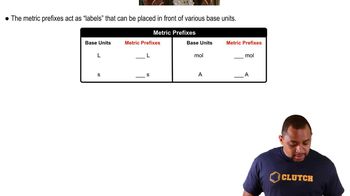
The metric system is a decimal-based system of measurement used globally, which includes units such as liters (L), deciliters (dL), and milliliters (mL). Understanding these units is essential for converting between them, as they are all related by powers of ten, making calculations straightforward.
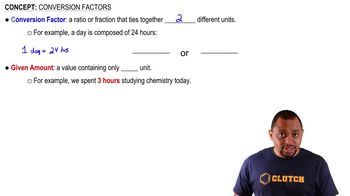
Unit conversion involves changing a quantity expressed in one unit to another unit without changing its value. This process often requires multiplication or division by a conversion factor, which is a ratio that expresses how many of one unit are equivalent to another unit, such as 1 dL = 100 mL.
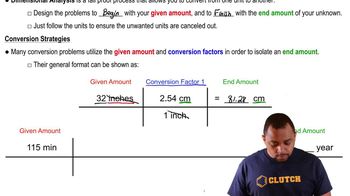
Dimensional analysis is a mathematical technique used to convert units by multiplying by conversion factors. It ensures that units cancel appropriately, leading to the desired unit in the final answer. This method is particularly useful in chemistry for ensuring that calculations are accurate and consistent.