For the reaction C(s, diamond) → C(s, graphite), ∆G = -0.693 kcal/mol (-2.90 kJ/mol) at 25 °C.
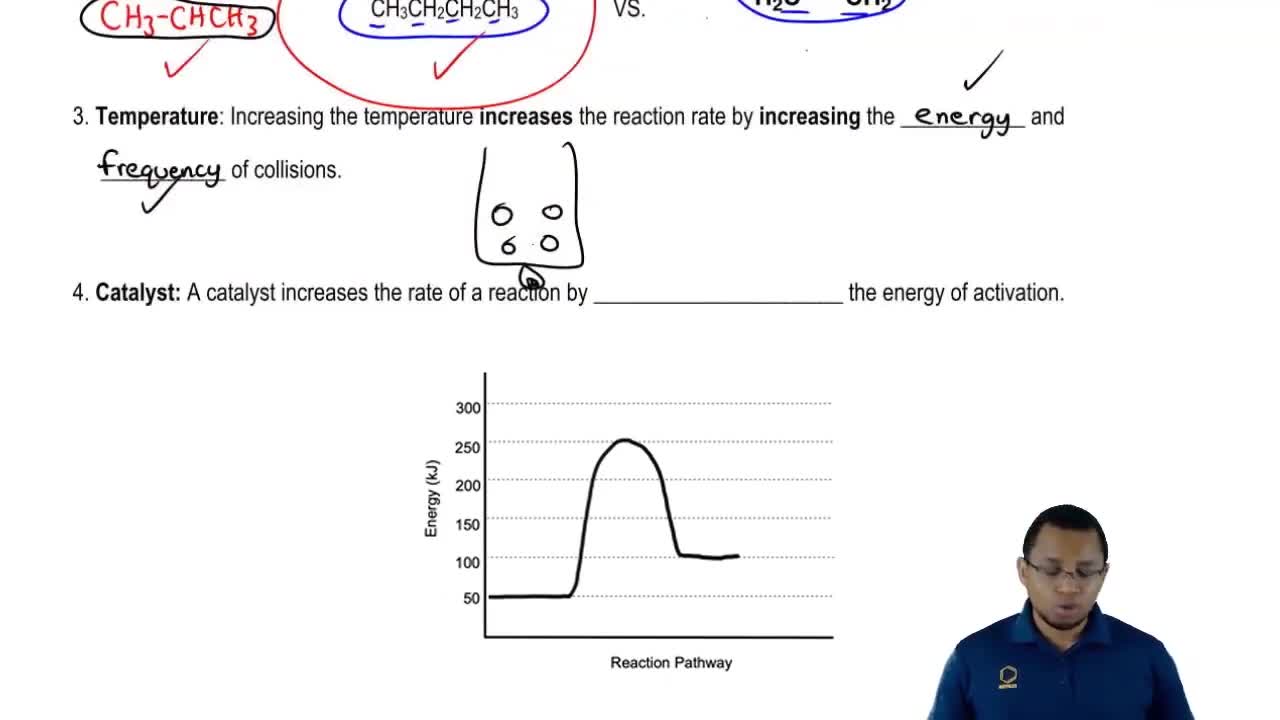
If a catalyst changes the activation energy of a forward reaction from 28.0 kcal/mol to 23.0 kcal/mol, what effect does it have on the reverse reaction?
Verified step by step guidance
1
Understand that a catalyst lowers the activation energy for both the forward and reverse reactions equally, without affecting the overall thermodynamics of the reaction.
Recognize that the activation energy for the reverse reaction is the difference between the activation energy of the forward reaction and the change in Gibbs free energy (\(\Delta G\)).
Calculate the original activation energy for the reverse reaction by adding the \(\Delta G\) of the reaction to the original activation energy of the forward reaction.
Calculate the new activation energy for the reverse reaction by adding the \(\Delta G\) of the reaction to the new activation energy of the forward reaction after the catalyst is applied.
Compare the original and new activation energies for the reverse reaction to determine the effect of the catalyst.
Verified video answer for a similar problem:
This video solution was recommended by our tutors as helpful for the problem above.
Video duration:
1m
Play a video:
0 Comments
Key Concepts
Here are the essential concepts you must grasp in order to answer the question correctly.
Activation Energy
Activation energy is the minimum energy required for a chemical reaction to occur. It represents the energy barrier that reactants must overcome to transform into products. A catalyst lowers the activation energy, allowing the reaction to proceed more easily and quickly, but it does not change the overall energy change (∆G) of the reaction.
Catalysis is the process by which a substance, known as a catalyst, increases the rate of a chemical reaction without being consumed in the process. Catalysts work by providing an alternative reaction pathway with a lower activation energy. While they speed up both the forward and reverse reactions, they do not alter the equilibrium position of the reaction.
The activation energy for the reverse reaction is related to that of the forward reaction. If a catalyst lowers the activation energy of the forward reaction, it will similarly lower the activation energy of the reverse reaction by the same amount. Therefore, if the forward reaction's activation energy decreases from 28.0 kcal/mol to 23.0 kcal/mol, the reverse reaction's activation energy will also decrease by the same amount, facilitating the reverse process.

 1:12 minutes
 Verified step by step guidance
 02:23
02:23