How would each of the following change the rate of the reaction shown here?
2SO₂(g) + O₂(g) → 2SO₃(g)
a. adding some SO₂(g)
Verified step by step guidance
1
Identify the reaction: 2SO₂(g) + O₂(g) → 2SO₃(g).
Understand that the rate of a reaction can be influenced by the concentration of reactants.
Recognize that adding more SO₂(g) increases its concentration in the reaction mixture.
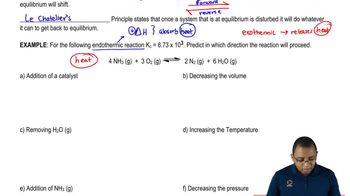
Apply Le Chatelier's Principle, which states that if a system at equilibrium is disturbed, it will adjust to minimize the disturbance.
Conclude that increasing the concentration of SO₂(g) will shift the equilibrium to the right, increasing the rate of formation of SO₃(g).
Verified video answer for a similar problem:
This video solution was recommended by our tutors as helpful for the problem above.
Video duration:
3m
Play a video:
0 Comments
Key Concepts
Here are the essential concepts you must grasp in order to answer the question correctly.
Reaction Rate
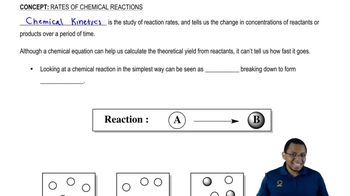
The reaction rate refers to the speed at which reactants are converted into products in a chemical reaction. It can be influenced by various factors, including concentration, temperature, and the presence of catalysts. In this case, the rate of the reaction can be affected by the concentration of SO₂, as increasing the amount of a reactant typically leads to more frequent collisions between reactant molecules, thereby increasing the reaction rate.
Le Chatelier's Principle states that if a dynamic equilibrium is disturbed by changing the conditions, the system will adjust to counteract the change and restore a new equilibrium. In the context of the given reaction, adding more SO₂ will shift the equilibrium position to the right, favoring the formation of SO₃, thus increasing the rate of the reaction until a new equilibrium is established.
The following is an endothermic reaction where Kc = 6.73 x 10³.For each of the choices below predict in which direction the reaction will proceed
Concentration Effects
Concentration effects refer to how the amount of reactants or products in a reaction mixture influences the rate of the reaction. Increasing the concentration of a reactant, such as SO₂ in this case, leads to a higher likelihood of collisions between reactant molecules, which can accelerate the reaction rate. This principle is fundamental in understanding how varying concentrations can impact chemical kinetics.

 3:08 minutes
 Verified step by step guidance
 01:07
01:07