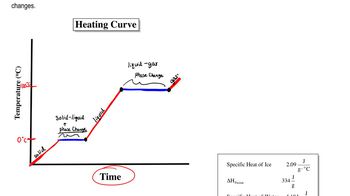
The heat of vaporization is the amount of energy required to convert a given amount of a liquid into a gas at its boiling point, without changing its temperature.
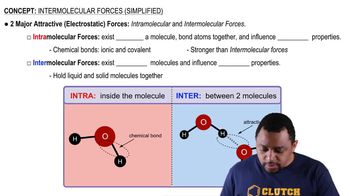
This process involves breaking the intermolecular forces that hold the liquid molecules together, allowing them to move freely as a gas.
The heat of vaporization is typically expressed in units of energy per mole, such as joules per mole (J/mol) or kilojoules per mole (kJ/mol).
To calculate the heat absorbed during vaporization, you can use the formula: \( q = n \times \Delta H_{vap} \), where \( q \) is the heat absorbed, \( n \) is the number of moles, and \( \Delta H_{vap} \) is the heat of vaporization.
Understanding the heat of vaporization is important in fields such as chemistry and engineering, as it helps predict how substances will behave under different temperature and pressure conditions.
Was this helpful?
Key Concepts
Here are the essential concepts you must grasp in order to answer the question correctly.
Heat of Vaporization
The heat of vaporization is the amount of energy required to convert a unit mass of a liquid into vapor without a change in temperature. This process occurs at the boiling point of the liquid and is crucial for understanding phase changes. It reflects the strength of intermolecular forces within the liquid; stronger forces result in a higher heat of vaporization.
Intermolecular forces are the attractive forces between molecules that influence physical properties such as boiling and melting points. These forces include hydrogen bonding, dipole-dipole interactions, and London dispersion forces. The type and strength of these forces determine how much energy is needed for a liquid to transition into a gas, directly affecting its heat of vaporization.
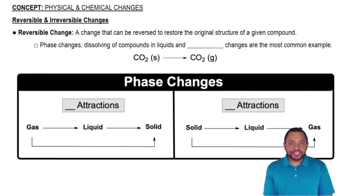
Phase changes refer to the transitions between solid, liquid, and gas states of matter, driven by energy changes. During these transitions, such as vaporization, energy is absorbed or released, affecting temperature and pressure. Understanding phase changes is essential for grasping concepts like heat of vaporization, as they illustrate how substances behave under varying conditions.