Classify the following liquid mixtures as heterogeneous or homogeneous. Further classify each homogeneous mixture as a solution or colloid.
Hand lotion
Verified step by step guidance
1
Understand the definitions: A heterogeneous mixture is one where the components are not uniformly distributed, and you can often see the different parts. A homogeneous mixture is one where the components are uniformly distributed throughout the mixture.
Identify the type of mixture: Hand lotion is typically a homogeneous mixture because it appears uniform throughout and you cannot see different components with the naked eye.
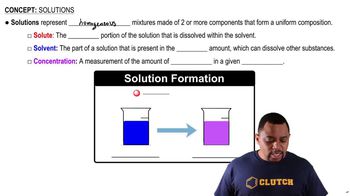
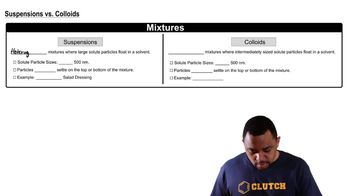
Further classify the homogeneous mixture: Homogeneous mixtures can be further classified as solutions or colloids. Solutions are mixtures where the solute is completely dissolved in the solvent, and the particles are at the molecular or ionic level. Colloids have larger particles than solutions, which are dispersed throughout the solvent but do not settle out.
Determine if hand lotion is a solution or colloid: Hand lotion is a colloid because it contains larger particles (such as emulsified oils and water) that are dispersed throughout the mixture but do not settle out over time.
Conclude the classification: Therefore, hand lotion is a homogeneous mixture and can be further classified as a colloid.
Verified video answer for a similar problem:
This video solution was recommended by our tutors as helpful for the problem above.
Video duration:
3m
Play a video:
0 Comments
Key Concepts
Here are the essential concepts you must grasp in order to answer the question correctly.
Heterogeneous vs. Homogeneous Mixtures
Mixtures can be classified as heterogeneous or homogeneous based on their composition. Heterogeneous mixtures consist of visibly different substances or phases, such as oil and water, where individual components can be identified. In contrast, homogeneous mixtures have a uniform composition throughout, meaning the individual components are not distinguishable, like saltwater.
A solution is a type of homogeneous mixture where one substance (the solute) is completely dissolved in another (the solvent). Solutions are characterized by their clear appearance and the inability to separate the solute from the solvent through filtration. Common examples include sugar dissolved in water and air, which is a solution of gases.
Colloids are another type of homogeneous mixture where fine particles of one substance are dispersed within another but do not settle out over time. Unlike solutions, colloids can scatter light, a phenomenon known as the Tyndall effect. Examples include milk and fog, where the dispersed particles are small enough to remain suspended but large enough to affect the mixture's properties.

 3:54 minutes
 Verified step by step guidance

 02:45
02:45