What is the concentration of a CO2 in a container after 4 half-lives if 0.325 mol of CO2 is initially placed into a 5.0 L reaction vessel?
Table of contents
- 1. The Chemical World9m
- 2. Measurement and Problem Solving2h 19m
- 3. Matter and Energy2h 15m
- Classification of Matter18m
- States of Matter8m
- Physical & Chemical Changes19m
- Chemical Properties8m
- Physical Properties5m
- Temperature (Simplified)9m
- Law of Conservation of Mass5m
- Nature of Energy5m
- First Law of Thermodynamics7m
- Endothermic & Exothermic Reactions7m
- Heat Capacity17m
- Thermal Equilibrium (Simplified)8m
- Intensive vs. Extensive Properties13m
- 4. Atoms and Elements2h 33m
- The Atom (Simplified)9m
- Subatomic Particles (Simplified)11m
- Isotopes17m
- Ions (Simplified)22m
- Atomic Mass (Simplified)17m
- Periodic Table: Element Symbols6m
- Periodic Table: Classifications11m
- Periodic Table: Group Names8m
- Periodic Table: Representative Elements & Transition Metals7m
- Periodic Table: Phases (Simplified)8m
- Periodic Table: Main Group Element Charges12m
- Atomic Theory9m
- Rutherford Gold Foil Experiment9m
- 5. Molecules and Compounds1h 50m
- Law of Definite Proportions9m
- Periodic Table: Elemental Forms (Simplified)6m
- Naming Monoatomic Cations6m
- Naming Monoatomic Anions5m
- Polyatomic Ions25m
- Naming Ionic Compounds11m
- Writing Formula Units of Ionic Compounds7m
- Naming Acids18m
- Naming Binary Molecular Compounds6m
- Molecular Models4m
- Calculating Molar Mass9m
- 6. Chemical Composition1h 23m
- 7. Chemical Reactions1h 43m
- 8. Quantities in Chemical Reactions1h 8m
- 9. Electrons in Atoms and the Periodic Table2h 32m
- Wavelength and Frequency (Simplified)5m
- Electromagnetic Spectrum (Simplified)11m
- Bohr Model (Simplified)9m
- Emission Spectrum (Simplified)3m
- Electronic Structure4m
- Electronic Structure: Shells5m
- Electronic Structure: Subshells4m
- Electronic Structure: Orbitals11m
- Electronic Structure: Electron Spin3m
- Electronic Structure: Number of Electrons4m
- The Electron Configuration (Simplified)20m
- The Electron Configuration: Condensed4m
- Ions and the Octet Rule9m
- Valence Electrons of Elements (Simplified)5m
- Periodic Trend: Metallic Character4m
- Periodic Trend: Atomic Radius (Simplified)7m
- Periodic Trend: Ionization Energy (Simplified)9m
- Periodic Trend: Electron Affinity (Simplified)7m
- Electron Arrangements5m
- The Electron Configuration: Exceptions (Simplified)12m
- 10. Chemical Bonding2h 10m
- Lewis Dot Symbols (Simplified)7m
- Ionic Bonding6m
- Covalent Bonds6m
- Lewis Dot Structures: Neutral Compounds (Simplified)8m
- Bonding Preferences6m
- Multiple Bonds4m
- Lewis Dot Structures: Multiple Bonds10m
- Lewis Dot Structures: Ions (Simplified)8m
- Lewis Dot Structures: Exceptions (Simplified)12m
- Resonance Structures (Simplified)5m
- Valence Shell Electron Pair Repulsion Theory (Simplified)4m
- Electron Geometry (Simplified)7m
- Molecular Geometry (Simplified)9m
- Bond Angles (Simplified)11m
- Dipole Moment (Simplified)14m
- Molecular Polarity (Simplified)7m
- 11 Gases2h 7m
- 12. Liquids, Solids, and Intermolecular Forces1h 11m
- 13. Solutions3h 1m
- 14. Acids and Bases2h 14m
- 15. Chemical Equilibrium1h 27m
- 16. Oxidation and Reduction1h 33m
- 17. Radioactivity and Nuclear Chemistry53m
17. Radioactivity and Nuclear Chemistry
Radioactive Half-Life
Problem 72
Textbook Question
Harmful chemical spills can often be cleaned up by treatment with another chemical. For example, a spill of H₂SO₄ might be neutralized by addition of NaHCO₃. Why is it that the harmful radioactive wastes from nuclear power plants cannot be cleaned up as easily?
Verified step by step guidance1
Understand the nature of the substances involved: H₂SO₄ is a strong acid, and NaHCO₃ is a base. When they react, they undergo a neutralization reaction, which is a chemical process that can be controlled and results in less harmful products.
Recognize the type of reaction: The reaction between H₂SO₄ and NaHCO₃ is a neutralization reaction, which typically results in the formation of water, carbon dioxide, and a salt (in this case, sodium sulfate). This is a straightforward chemical reaction.
Consider the nature of radioactive waste: Radioactive waste contains unstable isotopes that decay over time, releasing radiation. This is a nuclear process, not a chemical one, and involves changes in the nucleus of atoms rather than the rearrangement of electrons in chemical reactions.
Understand the challenges with radioactive waste: Unlike chemical reactions, nuclear reactions cannot be easily controlled or neutralized by adding another substance. The decay of radioactive materials is a process that occurs over long periods, and the waste remains hazardous until it has decayed to a safe level.
Explore the methods for dealing with radioactive waste: Instead of neutralization, radioactive waste management involves containment, storage, and isolation to prevent exposure to radiation, often requiring complex and long-term solutions.
Was this helpful?
Key Concepts
Here are the essential concepts you must grasp in order to answer the question correctly.
Acid-Base Neutralization
Acid-base neutralization is a chemical reaction where an acid reacts with a base to produce water and a salt, effectively reducing the acidity or basicity of a solution. In the example given, sulfuric acid (H₂SO₄) is neutralized by sodium bicarbonate (NaHCO₃), resulting in less harmful products. This process is straightforward for many common acids and bases, allowing for effective cleanup.
Recommended video:
Guided course
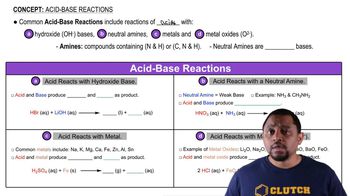
Acid-Base Reactions Concept 1
Radioactive Waste
Radioactive waste consists of materials that are radioactive and can remain hazardous for thousands of years. Unlike typical chemical spills, radioactive waste cannot be neutralized through simple chemical reactions. The isotopes present in radioactive waste decay over time, but their long half-lives and the nature of their radiation make them difficult to manage and require specialized containment and disposal methods.
Recommended video:
Guided course
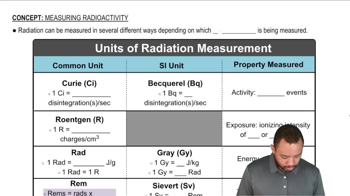
Measuring Radioactivity Concept 1
Chemical Stability and Reactivity
Chemical stability refers to how likely a substance is to undergo a chemical reaction. Many radioactive materials are chemically stable and do not react easily with other substances, making them resistant to neutralization. This stability complicates cleanup efforts, as traditional chemical treatments that work for non-radioactive spills may not be effective for radioactive materials, necessitating more complex and controlled disposal methods.
Recommended video:
Guided course
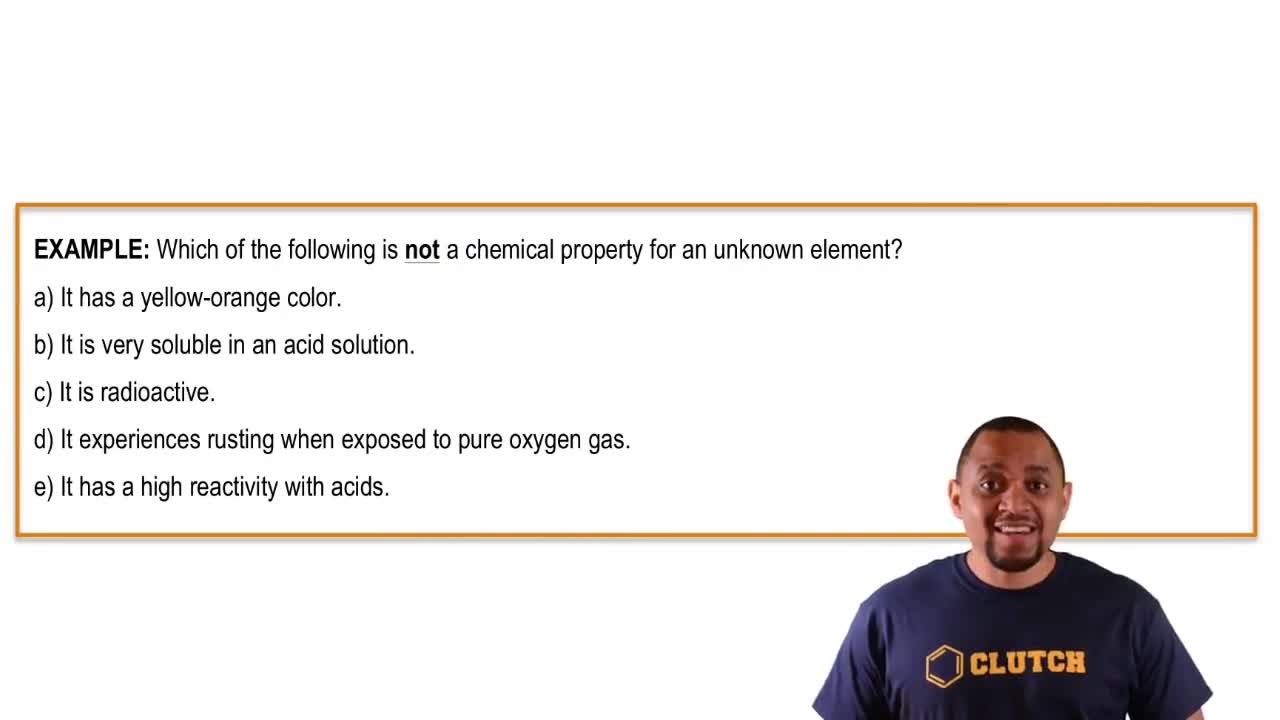
Chemical Properties Example 1
Watch next
Master Radioactive Half-Life Concept 1 with a bite sized video explanation from Jules
Start learningRelated Videos
Related Practice
Multiple Choice