Many allergy medications contain antihistamines, compounds that contain amine groups (R-NH₂, where R refers to an organic functional group). Would you expect these compounds to be acidic, basic or neutral? Explain.One over-the-counter product lists the active ingredient as 'diphenhydramine HCl.' What does this designation mean?
Verified step by step guidance
1
Understand the nature of amine groups: Amines (R-NH₂) are organic compounds that contain a nitrogen atom with a lone pair of electrons, making them basic in nature. This is because the lone pair can accept a proton (H⁺), which is a characteristic behavior of bases.
Consider the properties of diphenhydramine: Diphenhydramine is an antihistamine that contains an amine group, which suggests it is basic due to the presence of the nitrogen atom with a lone pair of electrons.
Interpret the 'HCl' in 'diphenhydramine HCl': The 'HCl' indicates that diphenhydramine is present as a hydrochloride salt. This means that the basic amine group has reacted with hydrochloric acid (HCl) to form a salt, which is a common way to make amine-containing drugs more stable and soluble.
Explain the formation of the hydrochloride salt: When diphenhydramine (a base) reacts with hydrochloric acid, it forms diphenhydramine hydrochloride, a salt. This reaction neutralizes the basicity of the amine group, making the compound more suitable for pharmaceutical use.
Summarize the overall acidity/basicity: While the free amine group in diphenhydramine is basic, the formation of the hydrochloride salt neutralizes this basicity, resulting in a compound that is neither strongly acidic nor basic in its final form as a medication.
Was this helpful?
Key Concepts
Here are the essential concepts you must grasp in order to answer the question correctly.
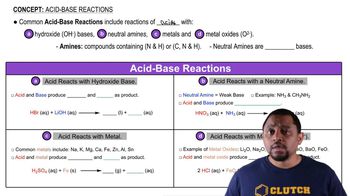
Acid-Base Properties of Amines
Amines, which contain nitrogen atoms bonded to hydrogen and/or carbon atoms, are generally considered basic due to the presence of a lone pair of electrons on the nitrogen. This lone pair can accept protons (H⁺), allowing amines to act as bases in acid-base reactions. Understanding this property is crucial for predicting the behavior of antihistamines in biological systems.
The pH of a solution indicates its acidity or basicity, which affects the ionization of compounds. For amines, their basic nature means they can accept protons, leading to the formation of positively charged ammonium ions in acidic environments. This ionization is important for understanding how antihistamines function in the body and their solubility in different pH conditions.
The designation 'HCl' in 'diphenhydramine HCl' indicates that diphenhydramine is present as a salt formed with hydrochloric acid. This salt formation enhances the stability and solubility of the drug in water, making it more effective for pharmaceutical use. Understanding this concept is essential for grasping how medications are formulated and how they behave in the body.