Why does the fourth period in the periodic table contain 18 elements?
Verified step by step guidance
1
Understand that the periodic table is organized by increasing atomic number and electron configuration.
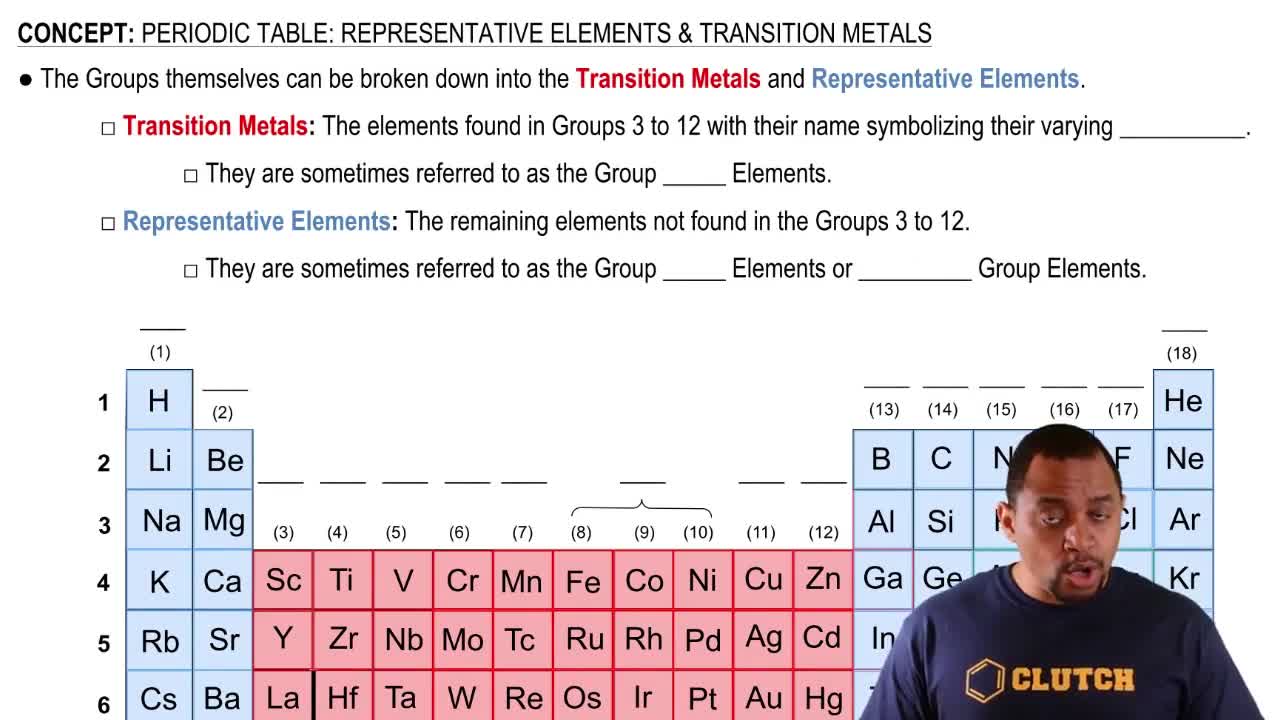
Recognize that the fourth period begins with potassium (K) and ends with krypton (Kr).
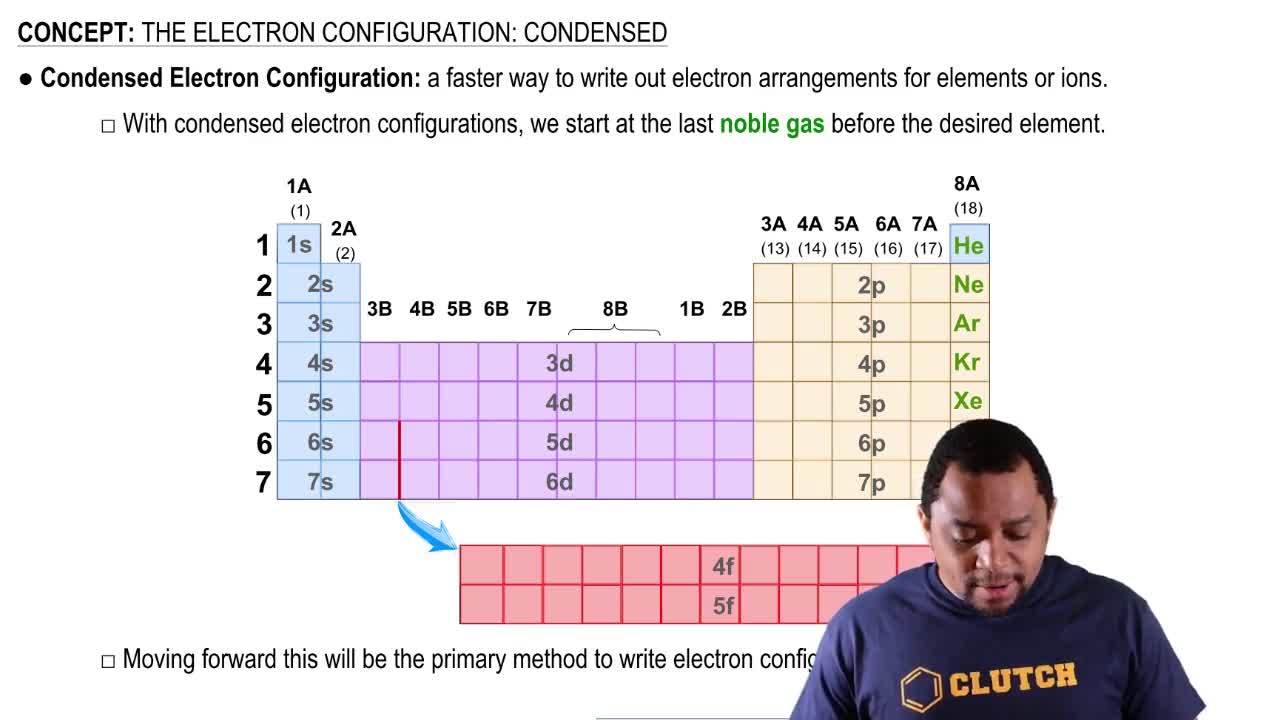
Recall that the fourth period includes the filling of the 4s, 3d, and 4p orbitals.
Note that the 4s orbital can hold 2 electrons, the 3d orbital can hold 10 electrons, and the 4p orbital can hold 6 electrons.
Add the maximum number of electrons that can be held in these orbitals: 2 (4s) + 10 (3d) + 6 (4p) = 18 electrons, which corresponds to 18 elements in the fourth period.
Verified video answer for a similar problem:
This video solution was recommended by our tutors as helpful for the problem above.
Video duration:
4m
Play a video:
0 Comments
Key Concepts
Here are the essential concepts you must grasp in order to answer the question correctly.
Periodic Table Structure
The periodic table is organized into periods (rows) and groups (columns) based on atomic number and electron configuration. Each period corresponds to the filling of electron shells, with the fourth period beginning to fill the 3d subshell after the 4s subshell is filled. This structure explains the number of elements in each period.
Electron configuration describes the distribution of electrons in an atom's orbitals. For the fourth period, elements have electrons filling the 4s and 3d orbitals, allowing for a total of 18 electrons (2 in 4s and 10 in 3d, plus 6 in 4p) across the 18 elements. Understanding this helps explain the number of elements in the period.
The fourth period includes transition metals, which are characterized by the presence of d electrons. These elements exhibit unique properties due to their electron configurations, contributing to the total count of 18 elements in this period. Transition metals play a significant role in chemistry due to their variable oxidation states and complex ion formation.

 4:25 minutes
 Verified step by step guidance
 02:40
02:40