Assume that two liquids are separated by a semipermeable membrane, with pure solvent on the right side and a solution of a solute on the left side. Make a drawing that shows the situation after equilibrium is reached.
Verified step by step guidance
1
Identify the components in the image: the semipermeable membrane, the pure solvent on the right, and the solution with solute particles on the left.
Understand that osmosis will occur, where the solvent molecules move from the pure solvent side to the solution side to equalize the concentration of solute on both sides of the membrane.
Recognize that at equilibrium, the flow of solvent molecules in both directions across the membrane will be equal, resulting in no net movement of solvent.
Visualize that the level of liquid on the solution side will be higher than on the pure solvent side due to the osmotic pressure.
Draw the final situation: the semipermeable membrane in the center, with a higher liquid level on the left side (solution) and a lower level on the right side (pure solvent).
Was this helpful?
Key Concepts
Here are the essential concepts you must grasp in order to answer the question correctly.
Osmosis
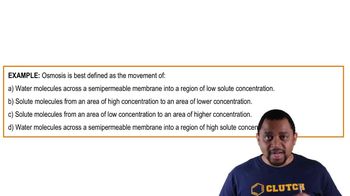
Osmosis is the movement of solvent molecules through a semipermeable membrane from an area of lower solute concentration to an area of higher solute concentration. This process continues until equilibrium is reached, where the concentrations on both sides of the membrane become equal. Osmosis is crucial in biological systems, influencing cell hydration and nutrient absorption.
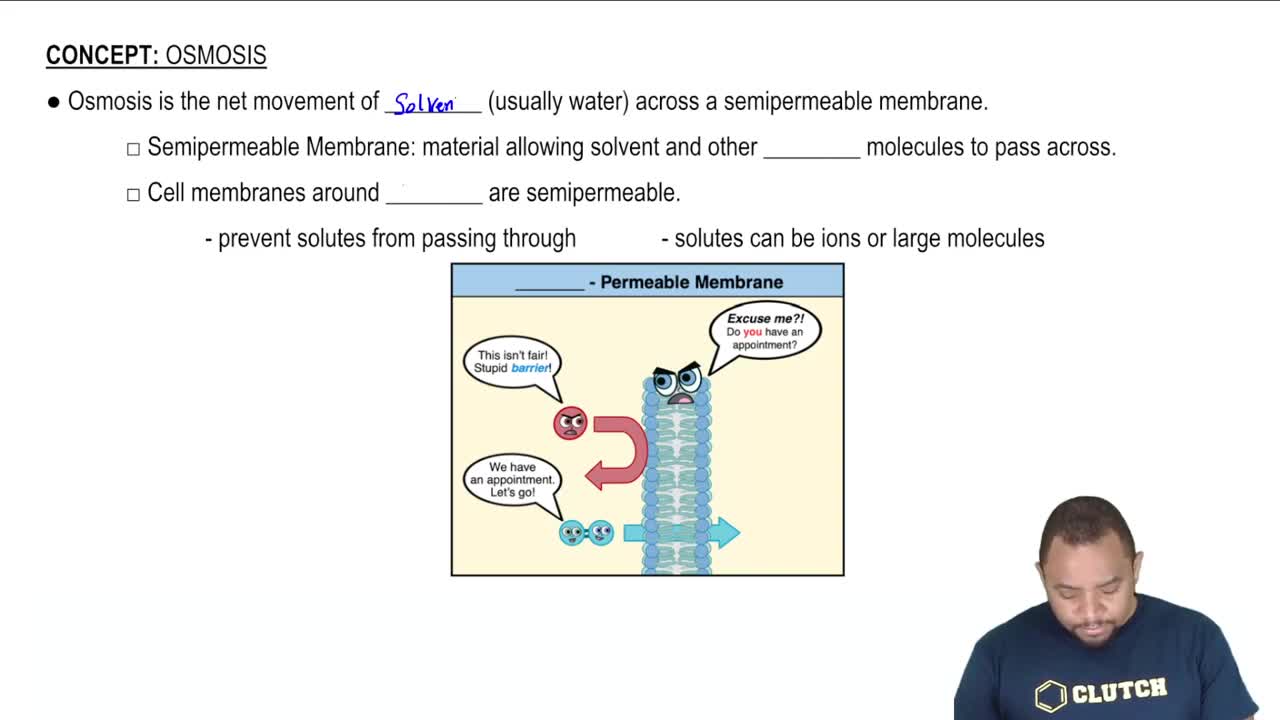
A semipermeable membrane is a barrier that allows certain molecules or ions to pass through while blocking others. In the context of osmosis, it permits the passage of solvent molecules (like water) but restricts solute particles (like salts or sugars). This selective permeability is essential for maintaining cellular homeostasis and regulating the internal environment of cells.
Equilibrium in a chemical context refers to a state where the concentrations of reactants and products remain constant over time, indicating that the forward and reverse processes occur at the same rate. In osmosis, equilibrium is achieved when the rate of solvent movement across the semipermeable membrane is equal in both directions, resulting in no net change in the concentration of solute on either side.