Use the following table for problems 9.25 to 9.28:
A solution containing 80. g of NaNO₃ in 75 g of H₂O at 50 °C is cooled to 20 °C.
b. How many grams of solid NaNO₃ crystallized after cooling?
Verified step by step guidance
1
Identify the solubility of NaNO₃ at both 50 °C and 20 °C using the provided table.
Determine how much NaNO₃ can remain dissolved in 75 g of H₂O at 20 °C.
Calculate the difference between the initial amount of NaNO₃ (80 g) and the amount that can remain dissolved at 20 °C.
The difference calculated in the previous step represents the amount of NaNO₃ that crystallized out of the solution.
Express the final answer in grams of NaNO₃ that crystallized.
Verified video answer for a similar problem:
This video solution was recommended by our tutors as helpful for the problem above.
Video duration:
6m
Play a video:
0 Comments
Key Concepts
Here are the essential concepts you must grasp in order to answer the question correctly.
Solubility and Temperature
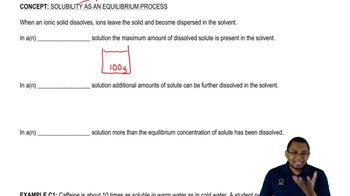
Solubility refers to the maximum amount of solute that can dissolve in a solvent at a given temperature. For many substances, solubility decreases as temperature decreases, meaning that a solution can hold less solute when cooled. Understanding this relationship is crucial for predicting how much solute will crystallize out of a solution when it is cooled.
The saturation point is the concentration of solute in a solution at which no more solute can dissolve at a specific temperature. When a solution is cooled, it may exceed this saturation point, leading to the formation of solid crystals. Knowing the saturation point of NaNO₃ at both 50 °C and 20 °C is essential for determining how much NaNO₃ will crystallize upon cooling.
Crystallization is the process where solute particles come together to form a solid phase from a solution. This occurs when the solution becomes supersaturated, often due to a decrease in temperature. Understanding the conditions that lead to crystallization helps in calculating the amount of solute that will precipitate out of the solution as it cools.


 04:38
04:38
 6:39 minutes