The Environmental Protection Agency has set the limit for arsenic in drinking water at 0.010 ppm. To what volume would you need to dilute 1.5 L of water containing 5.0 ppm arsenic to reach the acceptable limit?
Verified step by step guidance
1
Identify the initial concentration \( C_1 \) of arsenic in the water, which is 5.0 ppm.
Identify the final concentration \( C_2 \) that you want to achieve, which is 0.010 ppm.
Identify the initial volume \( V_1 \) of the water, which is 1.5 L.
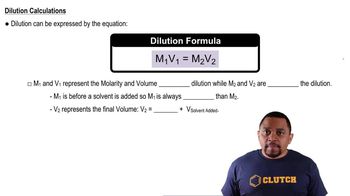
Use the dilution formula \( C_1 \times V_1 = C_2 \times V_2 \) to set up the equation for the final volume \( V_2 \).
Solve the equation for \( V_2 \) to find the volume to which the water needs to be diluted.
Was this helpful?
Key Concepts
Here are the essential concepts you must grasp in order to answer the question correctly.
Parts Per Million (ppm)
Parts per million (ppm) is a unit of measurement used to describe the concentration of a substance in a solution. It indicates how many parts of a substance are present in one million parts of the total solution. For example, 5.0 ppm means that there are 5 grams of arsenic in 1,000,000 grams of water, which is crucial for understanding the concentration levels in the context of environmental regulations.
Dilution is the process of reducing the concentration of a solute in a solution, typically by adding more solvent. The dilution equation, C1V1 = C2V2, relates the initial concentration (C1) and volume (V1) to the final concentration (C2) and volume (V2). This concept is essential for calculating how much additional water is needed to lower the arsenic concentration to the EPA's acceptable limit.
Concentration calculation involves determining the amount of solute in a given volume of solution. In this scenario, it requires calculating the total amount of arsenic in the initial solution and then using the desired final concentration to find the necessary final volume. Understanding how to manipulate these values is key to solving the dilution problem presented in the question.