Which number in each of the following pairs is smaller?a. 4.9 x 10⁻³ or 5.5 x 10⁻⁹
Verified step by step guidance
1
Step 1: Understand that both numbers are in scientific notation, which is a way to express very large or very small numbers.
Step 2: Compare the exponents of 10 in both numbers. The number with the smaller exponent is generally smaller.
Step 3: In this case, compare the exponents: -3 and -9. Since -9 is smaller than -3, the number with the exponent -9 is smaller.
Step 4: If the exponents were the same, you would then compare the coefficients (4.9 and 5.5) to determine which is smaller.
Step 5: Conclude that 5.5 x 10⁻⁹ is the smaller number because it has the smaller exponent.
Was this helpful?
Key Concepts
Here are the essential concepts you must grasp in order to answer the question correctly.
Scientific Notation
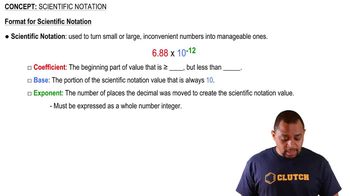
Scientific notation is a way of expressing numbers that are too large or too small to be conveniently written in decimal form. It is represented as a product of a number (between 1 and 10) and a power of ten. For example, 4.9 x 10⁻³ means 4.9 divided by 1000, which helps in comparing very small or very large values easily.
When comparing numbers in scientific notation, the exponent of ten plays a crucial role. A larger negative exponent indicates a smaller number. For instance, 10⁻³ (0.001) is larger than 10⁻⁹ (0.000000001), meaning that any number multiplied by 10⁻³ will be larger than the same number multiplied by 10⁻⁹, regardless of the coefficients.
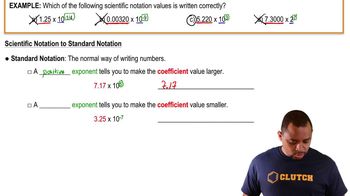
To compare numbers in scientific notation directly, converting them to decimal form can be helpful. For example, 4.9 x 10⁻³ converts to 0.0049, while 5.5 x 10⁻⁹ converts to 0.0000000055. This conversion allows for straightforward comparison of the two values, making it easier to determine which is smaller.