Consider the following Lewis symbols for elements X and Y: (6.1, 6.2, 6.5)
c. What ions would be formed by X and Y?
Verified step by step guidance
1
Identify the number of valence electrons for each element based on the Lewis symbols: M has 6 valence electrons and N has 1 valence electron.
Determine the tendency of each element to gain or lose electrons to achieve a stable electron configuration: M will likely gain 2 electrons to complete its octet, while N will likely lose 1 electron to achieve a stable configuration.
Predict the ions formed: M will form an anion by gaining electrons, and N will form a cation by losing an electron.
Write the expected ions: M will form M^{2-} and N will form N^{+}.
Consider the charge balance in a compound formed by these ions: The compound would be neutral if two N^{+} ions combine with one M^{2-} ion.
Verified video answer for a similar problem:
This video solution was recommended by our tutors as helpful for the problem above.
Video duration:
3m
Play a video:
0 Comments
Key Concepts
Here are the essential concepts you must grasp in order to answer the question correctly.
Lewis Dot Structures
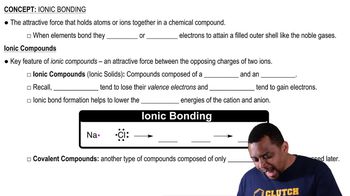
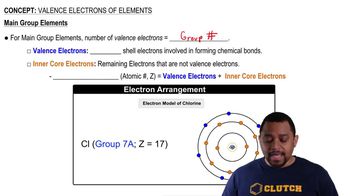
Lewis dot structures are diagrams that represent the valence electrons of an atom. Each dot corresponds to a valence electron, and the arrangement of these dots helps visualize how atoms bond with each other. Understanding these structures is crucial for predicting how elements will interact and form ions.
Ionic bonding occurs when atoms transfer electrons to achieve full valence shells, resulting in the formation of ions. Typically, metals lose electrons to become positively charged cations, while nonmetals gain electrons to become negatively charged anions. This transfer of electrons leads to the electrostatic attraction between oppositely charged ions.
Valence electrons are the outermost electrons of an atom and play a key role in chemical bonding. The number of valence electrons determines an element's reactivity and the types of ions it can form. Elements tend to lose, gain, or share valence electrons to achieve a stable electron configuration, often resembling that of noble gases.

 3:54 minutes
 Verified step by step guidance
 03:11
03:11