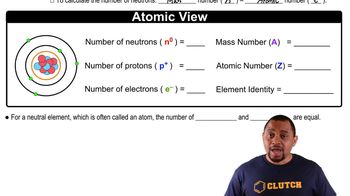
Step 1: Understand the notation ¹₀X. This is a nuclear symbol where the superscript (1) represents the mass number (A), and the subscript (0) represents the atomic number (Z).
Step 2: Recall that the mass number (A) is the total number of protons and neutrons in the nucleus of an atom.
Step 3: The atomic number (Z) is the number of protons in the nucleus, which also determines the element's identity on the periodic table.
Step 4: Since the atomic number (Z) is 0, this suggests that the element is not a typical atom found on the periodic table, as all known elements have at least one proton.
Step 5: Consider that ¹₀X could represent a neutron, as neutrons have a mass number of 1 and an atomic number of 0, meaning they have no protons.
Verified video answer for a similar problem:
This video solution was recommended by our tutors as helpful for the problem above.
Video duration:
2m
Play a video:
0 Comments
Key Concepts
Here are the essential concepts you must grasp in order to answer the question correctly.
Nuclear Notation
Nuclear notation is a way of representing isotopes of elements, where the element symbol is accompanied by two numbers. The superscript indicates the mass number (total protons and neutrons), while the subscript indicates the atomic number (number of protons). This notation helps in identifying the specific isotope and its properties.
Isotopes are variants of a particular chemical element that have the same number of protons but different numbers of neutrons. This results in different mass numbers for the isotopes. Understanding isotopes is crucial for applications in nuclear chemistry, medicine, and understanding elemental behavior.
Element identification involves recognizing elements based on their atomic number and symbol. Each element has a unique atomic number that corresponds to the number of protons in its nucleus. In the case of ¹₀X, the atomic number is zero, indicating it is a neutral particle, which could refer to a neutron or a hypothetical particle in certain contexts.

 2:46 minutes
 Verified step by step guidance
 01:41
01:41