Which assumptions of the kinetic–molecular theory explain the behavior of gases described by Gay-Lussac's law? Explain your answer.
Verified step by step guidance
1
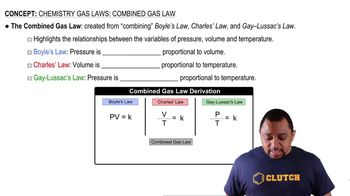
Gay-Lussac's law states that the pressure of a gas is directly proportional to its absolute temperature when the volume is held constant.
The kinetic-molecular theory of gases provides a framework to understand this behavior by making several key assumptions about gas particles.
One assumption is that gas particles are in constant, random motion, and their collisions with the walls of the container result in pressure.
Another assumption is that the average kinetic energy of gas particles is directly proportional to the absolute temperature of the gas.
As temperature increases, the average kinetic energy of the particles increases, leading to more frequent and forceful collisions with the container walls, thus increasing the pressure.
Was this helpful?
Key Concepts
Here are the essential concepts you must grasp in order to answer the question correctly.
Kinetic-Molecular Theory
The kinetic-molecular theory describes the behavior of gases in terms of particles in constant motion. It posits that gas particles are small, widely spaced, and move randomly at high speeds. This theory helps explain gas properties such as pressure, volume, and temperature, emphasizing that temperature is directly related to the average kinetic energy of the particles.
Gay-Lussac's law states that the pressure of a gas is directly proportional to its absolute temperature when the volume is held constant. This means that as the temperature increases, the kinetic energy of the gas particles increases, leading to more frequent and forceful collisions with the walls of the container, thus raising the pressure.
The assumptions of ideal gases include that gas particles do not attract or repel each other and that they occupy no volume. These assumptions simplify the behavior of gases and allow for the derivation of gas laws, including Gay-Lussac's law. While real gases deviate from these assumptions under high pressure and low temperature, they provide a useful framework for understanding gas behavior under typical conditions.