Give the full name of the following units:
a. cc
b. dm
c. mm
d. nL
e. mg
f. m³
Verified step by step guidance
1
Identify the common scientific or metric units that correspond to each abbreviation.
For 'cc', recognize that it stands for 'cubic centimeter', a unit of volume equivalent to a milliliter.
For 'dm', understand that it stands for 'decimeter', a unit of length in the metric system.
For 'mm', know that it stands for 'millimeter', another unit of length in the metric system.
For 'nL', realize that it stands for 'nanoliter', a unit of volume in the metric system.
For 'mg', recognize that it stands for 'milligram', a unit of mass in the metric system.
For 'm³', understand that it stands for 'cubic meter', a unit of volume in the metric system.
Verified video answer for a similar problem:
This video solution was recommended by our tutors as helpful for the problem above.
Video duration:
2m
Play a video:
0 Comments
Key Concepts
Here are the essential concepts you must grasp in order to answer the question correctly.
Metric System
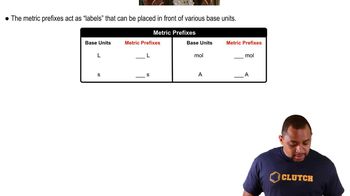
The metric system is a decimal-based system of measurement used globally, which includes units such as meters, liters, and grams. It is designed to be simple and consistent, allowing for easy conversion between units by powers of ten. Understanding the metric system is essential for interpreting and converting various units of measurement.
Units of measurement are standardized quantities used to express physical properties. In chemistry, common units include cubic centimeters (cc), decimeters (dm), millimeters (mm), nanoliters (nL), milligrams (mg), and cubic meters (m³). Each unit serves a specific purpose in quantifying substances, volumes, and masses in scientific contexts.
Conversion of units involves changing a measurement from one unit to another while maintaining its value. This is crucial in chemistry for ensuring accurate calculations and comparisons. Familiarity with conversion factors and the relationships between different metric units is necessary for effectively answering questions related to measurements.

 2:32 minutes
 Verified step by step guidance
 01:16
01:16