Use metric conversion factors to solve each of the following problems:
d. A balloon has a volume of 3500 cm³. What is the volume in liters?
Verified step by step guidance
1
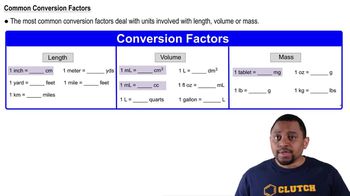
Identify the conversion factor between cubic centimeters and liters. Recall that 1 liter is equivalent to 1000 cubic centimeters (1 L = 1000 cm³).
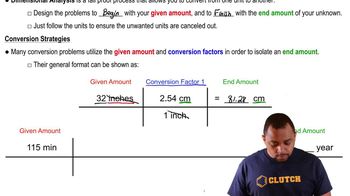
Set up the conversion by writing the given volume in cubic centimeters (3500 cm³) and multiply it by the conversion factor to convert to liters.
Express the conversion factor as a fraction that will cancel out the cubic centimeters and leave you with liters. This means you will use the conversion factor \( \frac{1 \text{ L}}{1000 \text{ cm}^3} \).
Multiply the given volume (3500 cm³) by the conversion factor \( \frac{1 \text{ L}}{1000 \text{ cm}^3} \) to convert the volume to liters.
Simplify the expression to find the volume in liters.
Verified video answer for a similar problem:
This video solution was recommended by our tutors as helpful for the problem above.
Video duration:
1m
Play a video:
0 Comments
Key Concepts
Here are the essential concepts you must grasp in order to answer the question correctly.
Metric Units
The metric system is a decimal-based system of measurement used globally, which includes units such as meters for length, grams for mass, and liters for volume. Understanding these units is essential for converting measurements accurately, as they provide a standardized way to express quantities.
Volume conversion involves changing a measurement from one unit to another, such as from cubic centimeters (cm³) to liters (L). Since 1 liter is equivalent to 1000 cubic centimeters, knowing this relationship allows for straightforward calculations when converting between these two volume units.
Dimensional analysis is a mathematical technique used to convert units by multiplying by conversion factors that express the relationship between different units. This method ensures that units cancel appropriately, leading to the desired unit in the final answer, making it a powerful tool in solving problems involving unit conversions.

 1:19 minutes
 Verified step by step guidance
 01:16
01:16