Titanium metal is obtained from the mineral rutile, TiO2. The process requires multiple steps, as shown in the following reactions:TiO2(S) + 2 Cl2(G) + 2 C(s) → TiCl4(s) + 2 CO(g)TiCl4(s) + 2 Mg(s) → Ti(s) + 2 MgCl2(s)Write mole ratios to show the relationship between the reactants and products for each reaction.
Verified step by step guidance
1
Identify the first reaction: \( \text{TiO}_2(s) + 2 \text{Cl}_2(g) + 2 \text{C}(s) \rightarrow \text{TiCl}_4(s) + 2 \text{CO}(g) \).
For the first reaction, write the mole ratios: \( 1 \text{ mole of } \text{TiO}_2 : 2 \text{ moles of } \text{Cl}_2 : 2 \text{ moles of } \text{C} : 1 \text{ mole of } \text{TiCl}_4 : 2 \text{ moles of } \text{CO} \).
Identify the second reaction: \( \text{TiCl}_4(s) + 2 \text{Mg}(s) \rightarrow \text{Ti}(s) + 2 \text{MgCl}_2(s) \).
For the second reaction, write the mole ratios: \( 1 \text{ mole of } \text{TiCl}_4 : 2 \text{ moles of } \text{Mg} : 1 \text{ mole of } \text{Ti} : 2 \text{ moles of } \text{MgCl}_2 \).
Understand that these mole ratios are derived from the coefficients in the balanced chemical equations, which indicate the proportion of reactants and products involved in the reactions.
Was this helpful?
Key Concepts
Here are the essential concepts you must grasp in order to answer the question correctly.
Stoichiometry
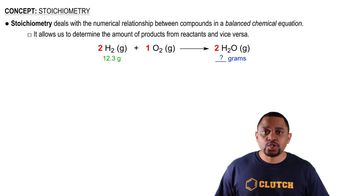
Stoichiometry is the branch of chemistry that deals with the quantitative relationships between the reactants and products in a chemical reaction. It allows chemists to calculate the amounts of substances consumed and produced in a reaction based on balanced chemical equations. Understanding stoichiometry is essential for determining mole ratios, which express the proportions of each substance involved in the reaction.
Mole ratios are derived from the coefficients of a balanced chemical equation and indicate the relative amounts of reactants and products involved in a reaction. For example, in the reaction 2 H2 + O2 → 2 H2O, the mole ratio of H2 to H2O is 1:1. These ratios are crucial for converting between moles of different substances and for predicting the outcomes of chemical reactions.
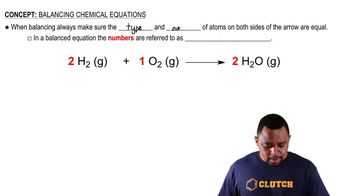
A balanced chemical equation represents a chemical reaction with equal numbers of each type of atom on both sides of the equation, adhering to the law of conservation of mass. Balancing equations ensures that the mass and charge are conserved throughout the reaction. This is fundamental for accurately writing mole ratios and understanding the stoichiometric relationships in the reactions being analyzed.