Use the heat equation to calculate the energy, in joules and calories, for each of the following (see TABLE3.11):c. lost when 15.0 g of ethanol, C₂H₆O, cools from 60.5 °C to−42.0 °C
Verified step by step guidance
1
Identify the specific heat capacity of ethanol. Since the table provides data for methanol, you may need to find the specific heat capacity for ethanol from another source or assume a similar value if instructed.
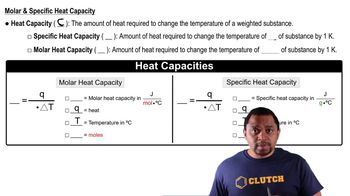
Use the heat equation: \( q = m \cdot c \cdot \Delta T \), where \( q \) is the heat energy, \( m \) is the mass, \( c \) is the specific heat capacity, and \( \Delta T \) is the change in temperature.
Calculate the change in temperature \( \Delta T \) by subtracting the final temperature from the initial temperature: \( \Delta T = -42.0 \, ^\circ\text{C} - 60.5 \, ^\circ\text{C} \).
Substitute the values into the heat equation: \( q = 15.0 \, \text{g} \times c \, \text{(J/g}^\circ\text{C)} \times \Delta T \).
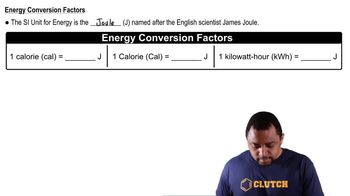
Convert the energy from joules to calories using the conversion factor: 1 calorie = 4.184 joules.
Was this helpful?
Key Concepts
Here are the essential concepts you must grasp in order to answer the question correctly.
Specific Heat Capacity
Specific heat capacity is the amount of heat energy required to raise the temperature of one gram of a substance by one degree Celsius. It is a crucial property that varies between different substances and is measured in joules per gram per degree Celsius (J/g°C) or calories per gram per degree Celsius (cal/g°C). Understanding specific heat capacity allows for the calculation of energy changes during temperature changes in a substance.
The heat equation, often expressed as Q = mcΔT, relates the heat energy (Q) absorbed or released by a substance to its mass (m), specific heat capacity (c), and the change in temperature (ΔT). This equation is fundamental in thermodynamics and is used to calculate the energy involved in heating or cooling processes. In this context, it helps determine the energy lost by ethanol as it cools.
Energy conversion refers to the process of changing energy from one form to another, such as converting joules to calories. Since different contexts may require different units of energy, understanding how to convert between these units is essential for accurate calculations. The conversion factor is 1 calorie = 4.184 joules, which is important when reporting energy changes in different units.