The specific heat of fat is 0.45 cal/(g ⋅ °C) (1.9 J/g °C) and the density of fat is 0.94 g/cm^3. How much energy (in calories and joules) is needed to heat 10 cm^3 of fat from room temperature (25 degree C) to its melting point (35 degree C)?
Verified step by step guidance
1
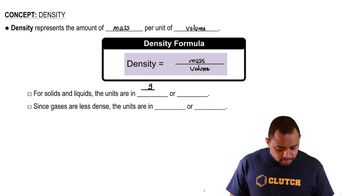
Determine the mass of the fat using its volume and density. Use the formula: \( \text{mass} = \text{density} \times \text{volume} \).
Calculate the change in temperature (\( \Delta T \)) by subtracting the initial temperature from the final temperature: \( \Delta T = 35^\circ C - 25^\circ C \).
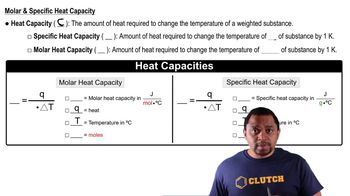
Use the formula for heat energy: \( q = m \cdot c \cdot \Delta T \), where \( q \) is the heat energy, \( m \) is the mass, \( c \) is the specific heat capacity, and \( \Delta T \) is the change in temperature.
Substitute the values for mass, specific heat capacity in calories, and \( \Delta T \) into the formula to find the energy in calories.
Substitute the values for mass, specific heat capacity in joules, and \( \Delta T \) into the formula to find the energy in joules.
Was this helpful?
Key Concepts
Here are the essential concepts you must grasp in order to answer the question correctly.
Specific Heat Capacity
Specific heat capacity is the amount of heat energy required to raise the temperature of a unit mass of a substance by one degree Celsius. It is a crucial concept in thermodynamics, as it determines how much energy is needed to change the temperature of a material. In this question, the specific heat of fat (0.45 cal/(g ⋅ °C) or 1.9 J/g °C) indicates how much energy is required to heat the fat.
Density is defined as mass per unit volume and is a key property of materials. It helps in determining how much mass is contained in a given volume of a substance. In this case, the density of fat (0.94 g/cm³) allows us to calculate the mass of the fat when given its volume (10 cm³), which is essential for calculating the total energy required to heat it.
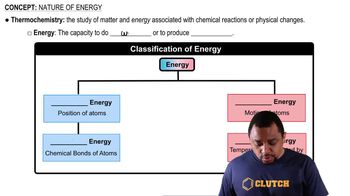
Energy calculation in thermodynamics often involves using the formula Q = mcΔT, where Q is the heat energy, m is the mass, c is the specific heat capacity, and ΔT is the change in temperature. This formula is fundamental for determining how much energy is needed to raise the temperature of a substance, as seen in this question where we need to calculate the energy required to heat fat from 25°C to 35°C.