hen 100 cal (418 J) of heat is applied to a 125 g sample, the temperature increases by 28 degree C. Calculate the specific heat of the sample and compare your answer to the values in Table 1.10. What is the identity of the sample?
Verified step by step guidance
1
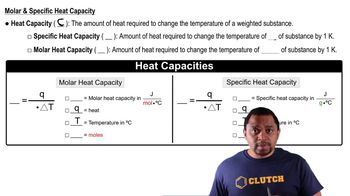
Identify the formula for specific heat capacity: \( c = \frac{q}{m \cdot \Delta T} \), where \( q \) is the heat added, \( m \) is the mass, and \( \Delta T \) is the change in temperature.
Substitute the given values into the formula: \( q = 418 \text{ J} \), \( m = 125 \text{ g} \), and \( \Delta T = 28 \degree C \).
Convert the mass from grams to kilograms if necessary, since specific heat is often expressed in \( \text{J/g} \cdot \degree C \) or \( \text{J/kg} \cdot \degree C \).
Calculate the specific heat \( c \) using the substituted values.
Compare the calculated specific heat value to those in Table 1.10 to identify the sample.
Was this helpful?
Key Concepts
Here are the essential concepts you must grasp in order to answer the question correctly.
Specific Heat Capacity
Specific heat capacity is the amount of heat required to raise the temperature of one gram of a substance by one degree Celsius. It is a material-specific property that helps in understanding how different substances respond to heat. The formula to calculate specific heat (c) is c = q / (m × ΔT), where q is the heat added, m is the mass, and ΔT is the change in temperature.
Heat transfer refers to the movement of thermal energy from one object or substance to another due to a temperature difference. In this context, heat is applied to the sample, causing its temperature to rise. Understanding the principles of heat transfer is essential for calculating changes in temperature and identifying materials based on their thermal properties.
Comparative analysis involves evaluating the calculated specific heat against known values in a reference table, such as Table 1.10. This process helps in identifying the substance by matching its specific heat with that of known materials. It is a critical step in experimental chemistry for confirming hypotheses and determining the identity of unknown samples.