Identify the most commonly used units for measuring pressure in chemistry and physics.
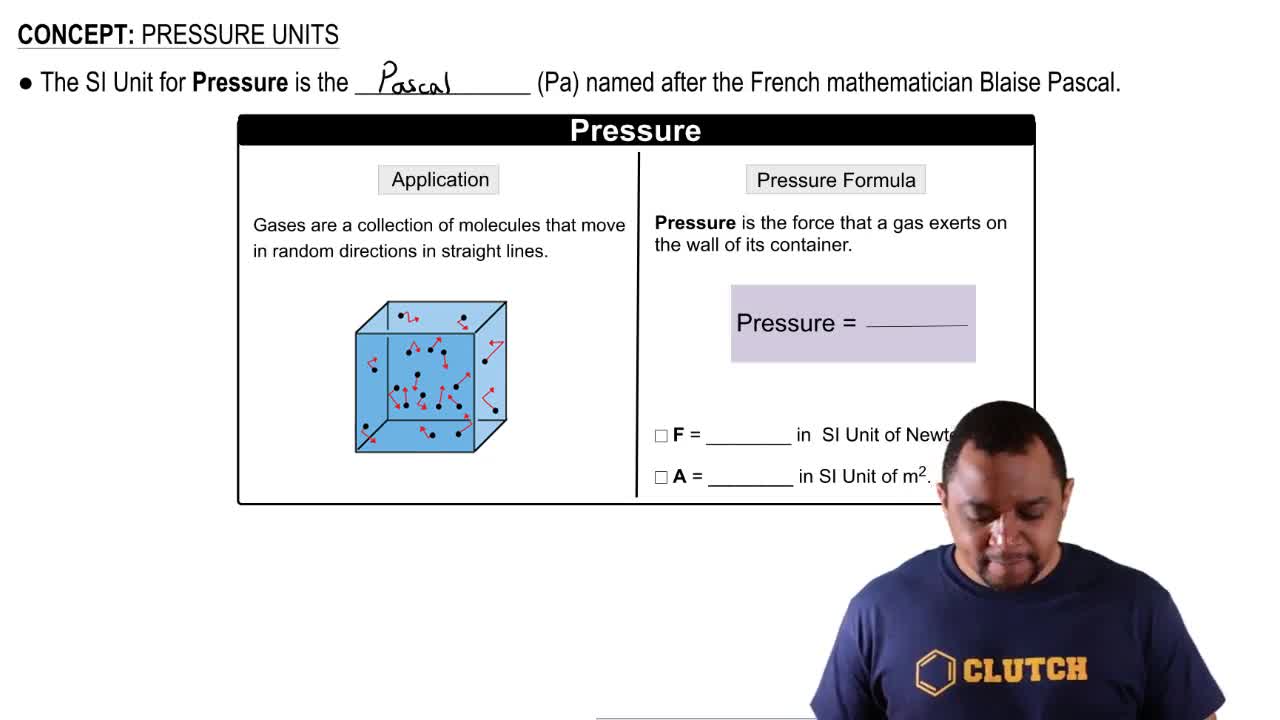
Consider the unit Pascal (Pa), which is the SI unit for pressure, defined as one newton per square meter.
Include the atmosphere (atm), a unit based on the average atmospheric pressure at sea level.
Mention the millimeter of mercury (mmHg), also known as torr, which is often used in measuring blood pressure and vacuum systems.
Add the bar, which is a metric unit of pressure, slightly less than the atmosphere, commonly used in meteorology and engineering.
Was this helpful?
Key Concepts
Here are the essential concepts you must grasp in order to answer the question correctly.
Pressure
Pressure is defined as the force exerted per unit area on a surface. It is a fundamental concept in physics and chemistry, influencing various phenomena such as gas behavior and fluid dynamics. Understanding pressure is essential for interpreting how gases expand, contract, and interact with their surroundings.
Units of measurement provide a standard way to quantify physical quantities. In the context of pressure, different units can be used depending on the application, such as atmospheres (atm), pascals (Pa), millimeters of mercury (mmHg), and pounds per square inch (psi). Familiarity with these units is crucial for accurate communication and calculations in scientific contexts.
Converting between different units of pressure is often necessary in scientific work to ensure consistency and accuracy. Each unit has a specific relationship with others, such as 1 atm being equivalent to 101.325 kPa or 760 mmHg. Understanding these conversions allows for effective comparison and analysis of pressure measurements across various contexts.