Determine the density (g/mL) for each of the following:
a. A 20.0-mL sample of a salt solution has a mass of 24.0 g.
Verified step by step guidance
1
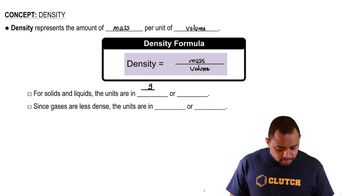
Identify the formula for density: \( \text{Density} = \frac{\text{Mass}}{\text{Volume}} \).
Determine the mass of the salt solution, which is given as 24.0 g.
Determine the volume of the salt solution, which is given as 20.0 mL.
Substitute the mass and volume values into the density formula: \( \text{Density} = \frac{24.0 \text{ g}}{20.0 \text{ mL}} \).
Simplify the expression to find the density in g/mL.
Verified video answer for a similar problem:
This video solution was recommended by our tutors as helpful for the problem above.
Video duration:
35s
Play a video:
0 Comments
Key Concepts
Here are the essential concepts you must grasp in order to answer the question correctly.
Density
Density is defined as the mass of a substance divided by its volume, typically expressed in grams per milliliter (g/mL) for liquids. It is a crucial physical property that helps identify substances and understand their behavior in different contexts. The formula for calculating density is: Density = Mass/Volume.
Mass is the amount of matter in an object, measured in grams (g), while volume is the space that a substance occupies, measured in milliliters (mL) for liquids. Accurate measurement of both mass and volume is essential for calculating density. In this question, the mass of the salt solution is given as 24.0 g, and the volume is 20.0 mL.
To calculate the density of a solution, you divide the mass of the solution by its volume. In this case, you would take the mass of 24.0 g and divide it by the volume of 20.0 mL. This calculation will yield the density of the salt solution, which is important for understanding its concentration and properties.

 0:35 minutes
 Verified step by step guidance
 01:56
01:56