In an old trunk, you find a piece of metal that you think maybe aluminum, silver, or lead. You take it to a lab, where you find it has a mass of 217 g and a volume of 19.2 cm³. Using TABLE2.8, what is the metal you found?
Verified step by step guidance
1
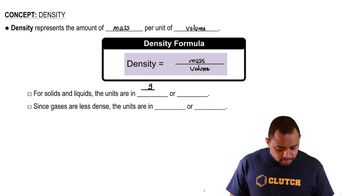
Identify the formula for density: \( \text{Density} = \frac{\text{Mass}}{\text{Volume}} \).
Substitute the given mass (217 g) and volume (19.2 cm³) into the density formula to calculate the density of the metal.
Compare the calculated density with the known densities of aluminum, silver, and lead from TABLE 2.8.
Determine which metal has a density that matches the calculated density.
Conclude the identity of the metal based on the matching density.
Was this helpful?
Key Concepts
Here are the essential concepts you must grasp in order to answer the question correctly.
Density
Density is defined as the mass of a substance divided by its volume, typically expressed in grams per cubic centimeter (g/cm³). It is a crucial property for identifying materials, as different substances have unique densities. In this case, calculating the density of the metal found will help determine whether it is aluminum, silver, or lead.
Different metals have characteristic densities that can be used for identification. For example, aluminum has a density of about 2.7 g/cm³, silver approximately 10.5 g/cm³, and lead around 11.3 g/cm³. By comparing the calculated density of the metal with known densities from a reference table, one can accurately identify the metal in question.
Understanding measurement units is essential in chemistry, particularly when dealing with mass and volume. Mass is measured in grams (g) and volume in cubic centimeters (cm³). Accurate conversion and comprehension of these units are necessary to calculate density correctly and make informed conclusions about the identity of the metal.