What is the density (g/mL) of each of the following samples?a. An ebony carving has a mass of 275 g and a volume of 207 cm³.
Verified step by step guidance
1
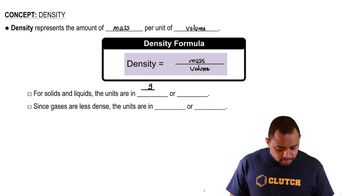
Identify the formula for density: \( \text{Density} = \frac{\text{Mass}}{\text{Volume}} \).
Substitute the given mass and volume into the formula. Here, mass = 275 g and volume = 207 cm³.
Calculate the density by dividing the mass by the volume: \( \text{Density} = \frac{275 \text{ g}}{207 \text{ cm}^3} \).
Since 1 cm³ is equivalent to 1 mL, the units for density will be g/mL.
The result from the calculation will give you the density of the ebony carving in g/mL.
Was this helpful?
Key Concepts
Here are the essential concepts you must grasp in order to answer the question correctly.
Density
Density is defined as the mass of an object divided by its volume, typically expressed in grams per milliliter (g/mL) or grams per cubic centimeter (g/cm³). It is a physical property that helps identify substances and can indicate whether an object will float or sink in a fluid. The formula for calculating density is D = m/V, where D is density, m is mass, and V is volume.
Mass is a measure of the amount of matter in an object, usually measured in grams (g), while volume is the amount of space that an object occupies, measured in cubic centimeters (cm³) or milliliters (mL). Understanding the relationship between mass and volume is crucial for calculating density. In this context, the mass of the ebony carving is given as 275 g, and its volume is 207 cm³.
Unit conversion is the process of converting a quantity expressed in one set of units to another. In the context of density, it is important to ensure that mass and volume are in compatible units for accurate calculations. Since 1 cm³ is equivalent to 1 mL, the volume of the ebony carving can be directly used in the density formula without conversion, simplifying the calculation.