What is the density (g/mL) of each of the following samples?
b. A syrup is added to an empty container with a mass of 115.25 g. When 0.100 pt of syrup is added, the total mass of the container and syrup is 182.48 g.
Verified step by step guidance
1
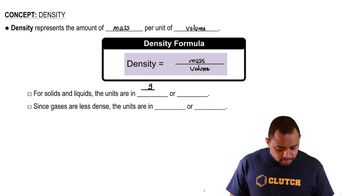
Identify the formula for density: \( \text{Density} = \frac{\text{Mass}}{\text{Volume}} \).
Calculate the mass of the syrup by subtracting the mass of the empty container from the total mass: \( \text{Mass of syrup} = 182.48\, \text{g} - 115.25\, \text{g} \).
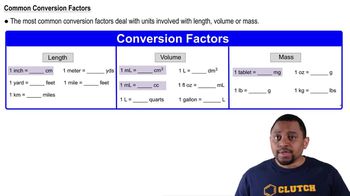
Convert the volume of syrup from pints to milliliters. Use the conversion factor: 1 pint = 473.176 mL.
Substitute the mass and converted volume into the density formula to find the density of the syrup.
Ensure units are consistent (grams for mass and milliliters for volume) before calculating the density.
Verified video answer for a similar problem:
This video solution was recommended by our tutors as helpful for the problem above.
Video duration:
4m
Play a video:
0 Comments
Key Concepts
Here are the essential concepts you must grasp in order to answer the question correctly.
Density
Density is defined as the mass of a substance divided by its volume, typically expressed in grams per milliliter (g/mL) for liquids. It is a crucial property that helps identify substances and understand their behavior in different contexts. In this question, calculating the density of the syrup requires knowing both its mass and the volume it occupies.
Mass is a measure of the amount of matter in an object, usually measured in grams (g). In this scenario, the mass of the empty container and the mass of the syrup combined are provided, allowing us to determine the mass of the syrup alone. Understanding how to manipulate these mass measurements is essential for calculating density accurately.
Volume is the amount of space that a substance occupies, often measured in liters or milliliters. The question specifies the volume of syrup in pints, which must be converted to milliliters for density calculation. Familiarity with unit conversions is vital in chemistry to ensure that all measurements are compatible and calculations yield correct results.

 4:32 minutes
 Verified step by step guidance
 01:56
01:56