Balance each of the following chemical equations:
d. Al(s) + HCl(aq) → H₂(g) + AlCl₃(aq)
Verified step by step guidance
1
Identify the reactants and products in the chemical equation: Al(s), HCl(aq) → H₂(g), AlCl₃(aq).
Write down the unbalanced equation: Al + HCl → H₂ + AlCl₃.
Count the number of atoms of each element on both sides of the equation.
Start balancing with the element that appears in the least number of compounds, usually metals or complex molecules. Here, start with Al and Cl.
Adjust coefficients to balance the number of atoms for each element on both sides of the equation, ensuring the same number of each type of atom appears on both sides.
Verified video answer for a similar problem:
This video solution was recommended by our tutors as helpful for the problem above.
Video duration:
5m
Play a video:
0 Comments
Key Concepts
Here are the essential concepts you must grasp in order to answer the question correctly.
Chemical Equations
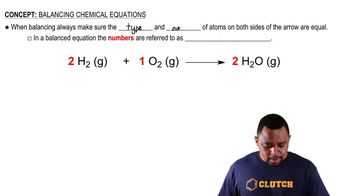
A chemical equation represents a chemical reaction using symbols and formulas. Reactants are shown on the left side, while products are on the right. Balancing a chemical equation ensures that the number of atoms for each element is the same on both sides, adhering to the law of conservation of mass.
Balancing Chemical Equations (Simplified) Concept 1
Balancing Techniques
Balancing chemical equations involves adjusting coefficients in front of the chemical formulas to achieve equal numbers of each type of atom on both sides. Common techniques include starting with the most complex molecule, balancing elements that appear in only one reactant and one product, and adjusting coefficients systematically to maintain balance.
Balancing Chemical Equations (Simplified) Concept 1
States of Matter
In chemical equations, the states of matter are indicated by symbols such as (s) for solid, (l) for liquid, (g) for gas, and (aq) for aqueous solutions. Understanding these states is crucial for interpreting the physical form of reactants and products, which can influence reaction conditions and outcomes.

 5:19 minutes
 Verified step by step guidance
 01:32
01:32