Today, thermometers containing mercury are used less frequently than in the past because of concerns regarding the toxicity of mercury and because of its relatively high melting point (-39 degree C). This means that mercury thermometers cannot be used in very cold environments because the mercury is a solid under such conditions. Alcohol thermometers, however, can be used over a temperature range from - 115 degree C (the melting point of alcohol) to 78.5 degree C (the boiling point of alcohol).b. The densities of alcohol and mercury are 0.79 g/mL and 13.6 g/mL, respectively. If the volume of liquid in a typical laboratory thermometer is 1.0 mL, what mass of alcohol is contained in the thermometer? What mass of mercury?
Verified step by step guidance
1
Identify the formula for density: \( \text{Density} = \frac{\text{Mass}}{\text{Volume}} \).
Rearrange the formula to solve for mass: \( \text{Mass} = \text{Density} \times \text{Volume} \).
Substitute the given density of alcohol (0.79 g/mL) and the volume (1.0 mL) into the formula to find the mass of alcohol.
Substitute the given density of mercury (13.6 g/mL) and the volume (1.0 mL) into the formula to find the mass of mercury.
Calculate the mass for each liquid using the rearranged formula and the provided values.
Was this helpful?
Key Concepts
Here are the essential concepts you must grasp in order to answer the question correctly.
Density
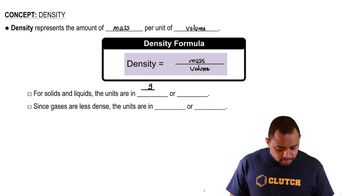
Density is defined as mass per unit volume, typically expressed in grams per milliliter (g/mL). It is a crucial property that helps determine how much mass a substance will have for a given volume. For example, if a liquid has a density of 0.79 g/mL, then 1.0 mL of that liquid will have a mass of 0.79 grams. Understanding density is essential for calculating the mass of liquids in thermometers.
Mass calculation involves using the formula: mass = density × volume. This relationship allows us to find the mass of a substance when its density and volume are known. In the context of the question, knowing the densities of alcohol and mercury enables us to calculate their respective masses when the volume of liquid in the thermometer is given as 1.0 mL.
Thermometers function by measuring temperature through the expansion or contraction of a liquid, such as mercury or alcohol, in a calibrated tube. The choice of liquid affects the thermometer's operational range and sensitivity. Mercury thermometers are limited by mercury's high melting point, while alcohol thermometers can operate in much colder environments, making them more versatile for low-temperature measurements.