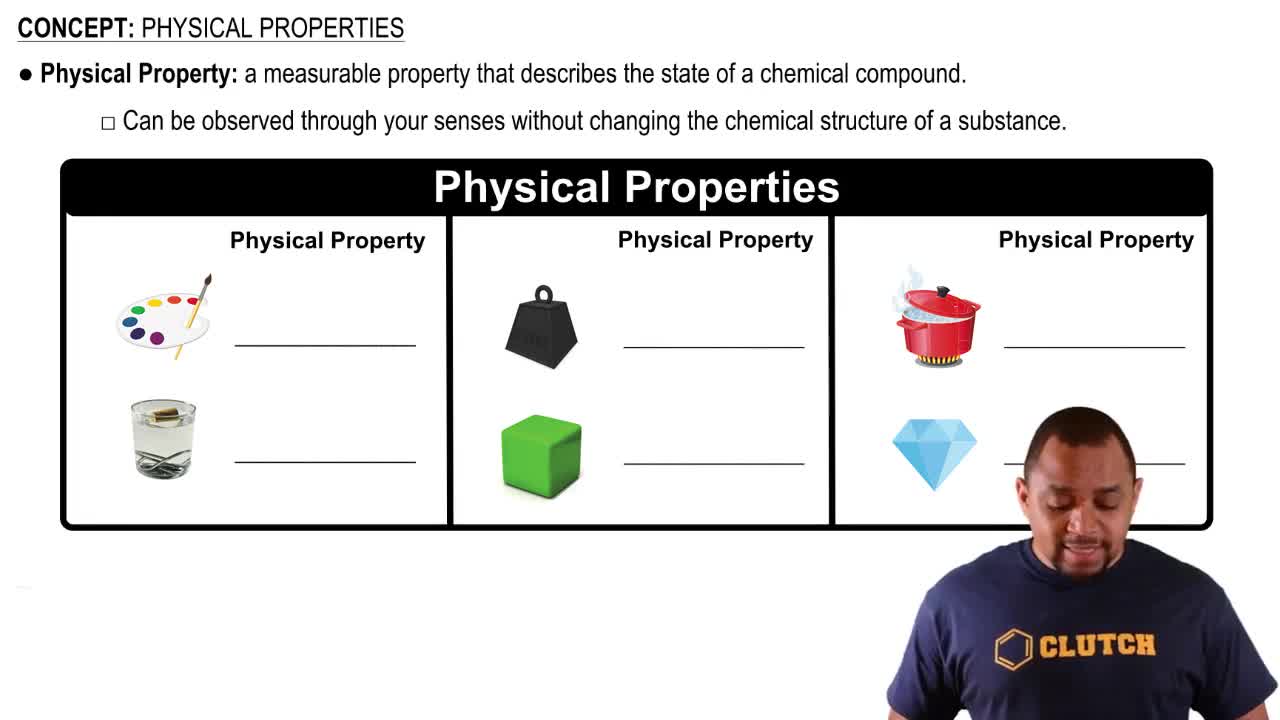
The gray cube has a density of 4.5 g/cm³. Is the density of the green cube the same, lower than, or higher than that of the gray cube? (2.7)
Verified step by step guidance
1
Identify the density of the gray cube, which is given as 4.5 g/cm³.
Note the density of the green cube, which is given as 2.7 g/cm³.
Compare the two densities: 4.5 g/cm³ for the gray cube and 2.7 g/cm³ for the green cube.
Determine if 2.7 g/cm³ is less than, equal to, or greater than 4.5 g/cm³.
Conclude that the density of the green cube is lower than that of the gray cube.
Was this helpful?
Key Concepts
Here are the essential concepts you must grasp in order to answer the question correctly.
Density
Density is defined as mass per unit volume, typically expressed in grams per cubic centimeter (g/cm³). It is a physical property that helps identify substances and can indicate whether an object will float or sink in a fluid. In this context, the density of the gray cube is given as 4.5 g/cm³, which serves as a reference point for comparison with the green cube.
When comparing the densities of two objects, one can determine which is denser by examining their mass and volume. If the green cube has a greater mass for the same volume as the gray cube, it will have a higher density. Conversely, if it has less mass, its density will be lower. This comparison is crucial for answering the question regarding the green cube's density relative to the gray cube.
Different materials have characteristic densities that can help identify them. For example, metals typically have higher densities than plastics or wood. Understanding the material properties of the cubes can provide insights into their densities. If the green cube is made of a lighter material than the gray cube, it is likely to have a lower density, while a denser material would suggest a higher density.