Is the yield of SO3 at equilibrium favored by a higher or lower pressure? By a higher or lower temperature?2 SO2(g) + O2 ⇌ 2 SO3(g) ∆H = -47 kcal/mol
Verified step by step guidance
1
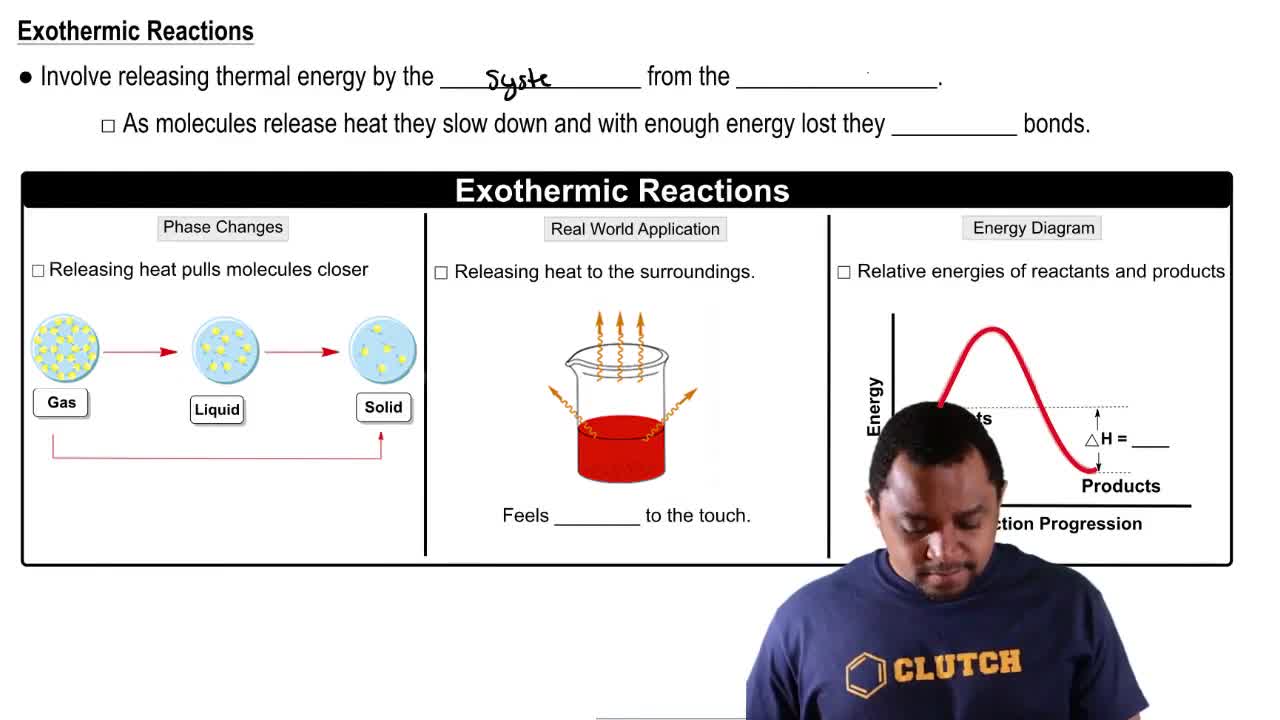
Identify the reaction type: The given reaction is an exothermic reaction, as indicated by the negative \( \Delta H \) value (-47 kcal/mol).
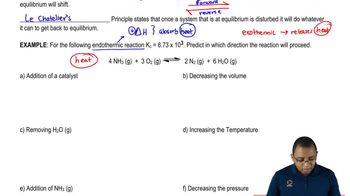
Apply Le Chatelier's Principle: This principle states that if a dynamic equilibrium is disturbed by changing the conditions, the position of equilibrium shifts to counteract the change.
Consider the effect of pressure: Increasing pressure favors the side of the reaction with fewer moles of gas. In this reaction, 2 moles of \( SO_2 \) and 1 mole of \( O_2 \) react to form 2 moles of \( SO_3 \). Since there are fewer moles of gas on the product side, higher pressure will favor the formation of \( SO_3 \).
Consider the effect of temperature: For exothermic reactions, increasing the temperature shifts the equilibrium to the left (towards the reactants), while decreasing the temperature shifts it to the right (towards the products). Therefore, a lower temperature will favor the formation of \( SO_3 \).
Summarize the conditions: The yield of \( SO_3 \) at equilibrium is favored by higher pressure and lower temperature.
Was this helpful?
Key Concepts
Here are the essential concepts you must grasp in order to answer the question correctly.
Le Chatelier's Principle
Le Chatelier's Principle states that if a dynamic equilibrium is disturbed by changing the conditions, the system will adjust to counteract the change and restore a new equilibrium. In the context of pressure, increasing the pressure will favor the side of the reaction with fewer gas molecules, while decreasing pressure will favor the side with more gas molecules.
The following is an endothermic reaction where Kc = 6.73 x 10³.For each of the choices below predict in which direction the reaction will proceed
Equilibrium Constant (K)
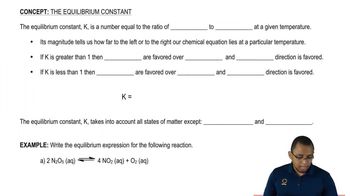
The equilibrium constant (K) quantifies the ratio of the concentrations of products to reactants at equilibrium for a given reaction at a specific temperature. For the reaction provided, K will change with temperature, influencing the position of equilibrium and the yield of SO3. A lower temperature favors exothermic reactions, while a higher temperature favors endothermic reactions.
An exothermic reaction is one that releases heat, indicated by a negative enthalpy change (∆H). In this case, the formation of SO3 from SO2 and O2 is exothermic (∆H = -47 kcal/mol). Lowering the temperature will favor the production of SO3, as the system will shift to produce more heat in response to the temperature decrease.