For the unbalanced combustion reaction shown, 1 mol of ethanol, C2H5OH, releases 327 kcal (1370 kJ):
C2H5OH + O2 → CO2 + H2O
If the density of ethanol is 0.789 g/mL, calculate the combustion energy of ethanol in kilocalories/milliliter and kilojoules/milliliter
Verified step by step guidance
1
Identify the molar mass of ethanol (C_2H_5OH) by adding the atomic masses of its constituent atoms: 2 carbon atoms, 6 hydrogen atoms, and 1 oxygen atom.
Calculate the mass of 1 mole of ethanol using its molar mass.
Use the given density of ethanol (0.789 g/mL) to find the volume of 1 mole of ethanol in milliliters.
Determine the combustion energy per milliliter by dividing the total energy released by 1 mole of ethanol (327 kcal or 1370 kJ) by the volume of 1 mole of ethanol in milliliters.
Express the combustion energy in both kilocalories/milliliter and kilojoules/milliliter.
Verified video answer for a similar problem:
This video solution was recommended by our tutors as helpful for the problem above.
Video duration:
4m
Play a video:
0 Comments
Key Concepts
Here are the essential concepts you must grasp in order to answer the question correctly.
Combustion Reactions
Combustion reactions are exothermic processes where a substance reacts with oxygen to produce heat, light, carbon dioxide, and water. In this case, ethanol (C2H5OH) combusts in the presence of oxygen (O2), releasing energy. Understanding the stoichiometry of the reaction is crucial for calculating energy release per unit of volume.
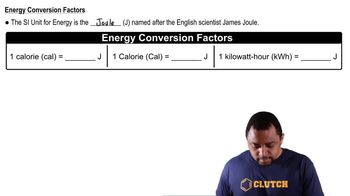
Energy conversion involves changing energy from one form to another, such as converting kilocalories to kilojoules. The conversion factor is 1 kcal = 4.184 kJ. This is important for expressing the combustion energy of ethanol in both kilocalories and kilojoules per milliliter, allowing for a comprehensive understanding of energy output.
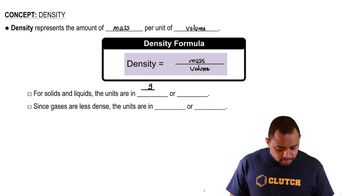
Density is defined as mass per unit volume and is crucial for converting between mass and volume. Given the density of ethanol (0.789 g/mL), one can calculate the mass of ethanol in a specific volume, which is necessary to determine the energy released per milliliter. This relationship is essential for solving the problem accurately.

 4:01 minutes
 Verified step by step guidance
 04:07
04:07