Table of contents
- 1. The Chemical World9m
- 2. Measurement and Problem Solving2h 19m
- 3. Matter and Energy2h 15m
- Classification of Matter18m
- States of Matter8m
- Physical & Chemical Changes19m
- Chemical Properties8m
- Physical Properties5m
- Temperature (Simplified)9m
- Law of Conservation of Mass5m
- Nature of Energy5m
- First Law of Thermodynamics7m
- Endothermic & Exothermic Reactions7m
- Heat Capacity17m
- Thermal Equilibrium (Simplified)8m
- Intensive vs. Extensive Properties13m
- 4. Atoms and Elements2h 33m
- The Atom (Simplified)9m
- Subatomic Particles (Simplified)11m
- Isotopes17m
- Ions (Simplified)22m
- Atomic Mass (Simplified)17m
- Periodic Table: Element Symbols6m
- Periodic Table: Classifications11m
- Periodic Table: Group Names8m
- Periodic Table: Representative Elements & Transition Metals7m
- Periodic Table: Phases (Simplified)8m
- Periodic Table: Main Group Element Charges12m
- Atomic Theory9m
- Rutherford Gold Foil Experiment9m
- 5. Molecules and Compounds1h 50m
- Law of Definite Proportions9m
- Periodic Table: Elemental Forms (Simplified)6m
- Naming Monoatomic Cations6m
- Naming Monoatomic Anions5m
- Polyatomic Ions25m
- Naming Ionic Compounds11m
- Writing Formula Units of Ionic Compounds7m
- Naming Acids18m
- Naming Binary Molecular Compounds6m
- Molecular Models4m
- Calculating Molar Mass9m
- 6. Chemical Composition1h 23m
- 7. Chemical Reactions1h 43m
- 8. Quantities in Chemical Reactions1h 8m
- 9. Electrons in Atoms and the Periodic Table2h 32m
- Wavelength and Frequency (Simplified)5m
- Electromagnetic Spectrum (Simplified)11m
- Bohr Model (Simplified)9m
- Emission Spectrum (Simplified)3m
- Electronic Structure4m
- Electronic Structure: Shells5m
- Electronic Structure: Subshells4m
- Electronic Structure: Orbitals11m
- Electronic Structure: Electron Spin3m
- Electronic Structure: Number of Electrons4m
- The Electron Configuration (Simplified)20m
- The Electron Configuration: Condensed4m
- Ions and the Octet Rule9m
- Valence Electrons of Elements (Simplified)5m
- Periodic Trend: Metallic Character4m
- Periodic Trend: Atomic Radius (Simplified)7m
- Periodic Trend: Ionization Energy (Simplified)9m
- Periodic Trend: Electron Affinity (Simplified)7m
- Electron Arrangements5m
- The Electron Configuration: Exceptions (Simplified)12m
- 10. Chemical Bonding2h 10m
- Lewis Dot Symbols (Simplified)7m
- Ionic Bonding6m
- Covalent Bonds6m
- Lewis Dot Structures: Neutral Compounds (Simplified)8m
- Bonding Preferences6m
- Multiple Bonds4m
- Lewis Dot Structures: Multiple Bonds10m
- Lewis Dot Structures: Ions (Simplified)8m
- Lewis Dot Structures: Exceptions (Simplified)12m
- Resonance Structures (Simplified)5m
- Valence Shell Electron Pair Repulsion Theory (Simplified)4m
- Electron Geometry (Simplified)7m
- Molecular Geometry (Simplified)9m
- Bond Angles (Simplified)11m
- Dipole Moment (Simplified)14m
- Molecular Polarity (Simplified)7m
- 11 Gases2h 7m
- 12. Liquids, Solids, and Intermolecular Forces1h 11m
- 13. Solutions3h 1m
- 14. Acids and Bases2h 14m
- 15. Chemical Equilibrium1h 27m
- 16. Oxidation and Reduction1h 33m
- 17. Radioactivity and Nuclear Chemistry53m
15. Chemical Equilibrium
Le Chatelier's Principle
Problem 66
Textbook Question
The reaction Fe 3+(aq) + Cl -(aq) ⇌ FeCl 2+(aq) is endothermic. How will the equilibrium concentration of FeCl 2+ change whenCl - is precipitated by addition of AgNO3?
Verified step by step guidance1
Identify the initial equilibrium reaction: Fe^{3+}(aq) + Cl^{-}(aq) \rightleftharpoons FeCl^{2+}(aq).
Recognize that the reaction is endothermic, meaning it absorbs heat.
Understand that adding AgNO_3 will precipitate Cl^{-} as AgCl, reducing the concentration of Cl^{-} ions in the solution.
Apply Le Chatelier's Principle: the system will shift to counteract the change, in this case, to increase the concentration of Cl^{-} ions.
Conclude that the equilibrium will shift to the left, decreasing the concentration of FeCl^{2+} ions.
Was this helpful?
Key Concepts
Here are the essential concepts you must grasp in order to answer the question correctly.
Le Chatelier's Principle
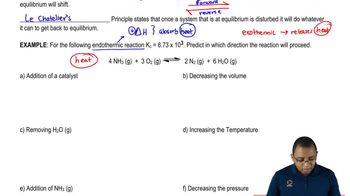
Le Chatelier's Principle states that if a dynamic equilibrium is disturbed by changing the conditions, the position of equilibrium shifts to counteract the change. In this case, adding AgNO3 precipitates Cl-, which reduces its concentration in the solution. According to Le Chatelier's Principle, the equilibrium will shift to the left to produce more Cl- ions, thereby affecting the concentration of FeCl2+.
Recommended video:
Guided course
The following is an endothermic reaction where Kc = 6.73 x 10³.For each of the choices below predict in which direction the reaction will proceed
Equilibrium Constant (K)
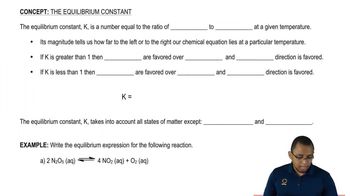
The equilibrium constant (K) is a numerical value that expresses the ratio of the concentrations of products to reactants at equilibrium for a given reaction at a specific temperature. For the reaction in question, K is determined by the concentrations of Fe3+, Cl-, and FeCl2+. Changes in concentration due to precipitation will influence the system's ability to maintain this constant, leading to shifts in the equilibrium position.
Recommended video:
Guided course
The Equilibrium Constant Concept 1
Endothermic Reactions
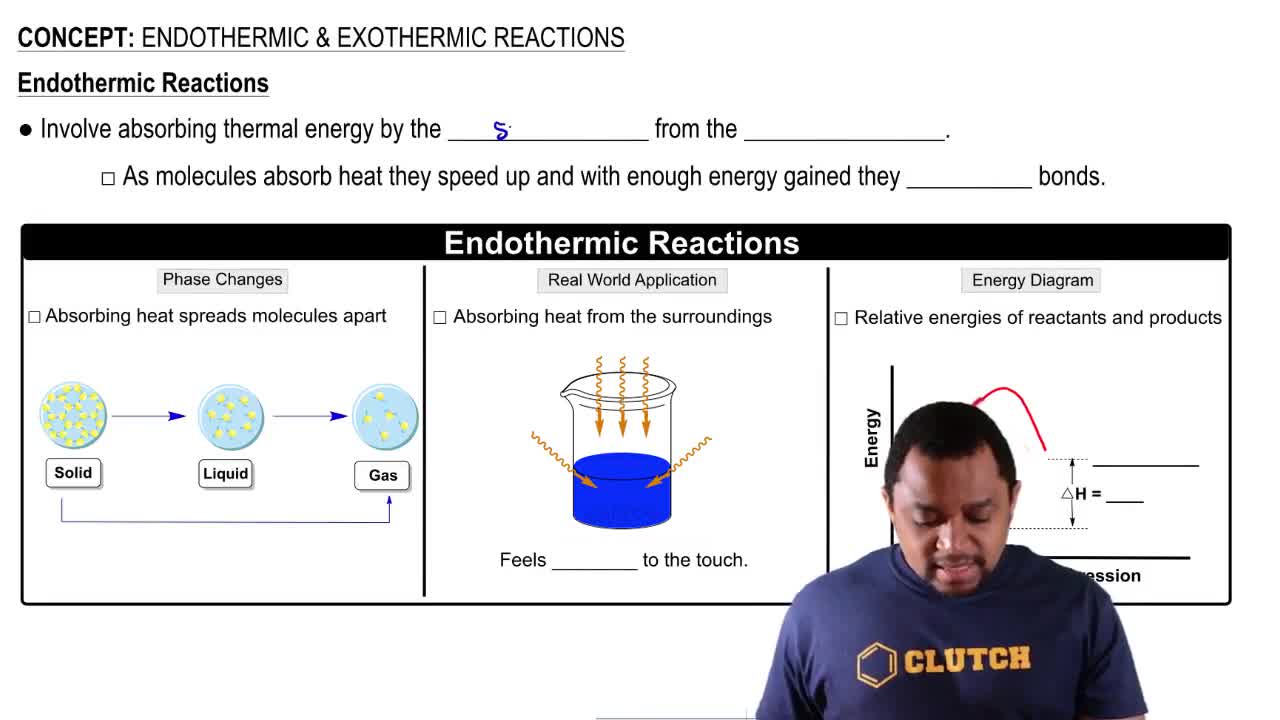
An endothermic reaction is one that absorbs heat from its surroundings, resulting in a decrease in temperature of the environment. In the context of the given reaction, the endothermic nature means that increasing temperature would favor the formation of products. However, since the question focuses on the effect of Cl- precipitation, the heat aspect is less relevant, but understanding the energy dynamics can help in predicting how the system responds to changes.
Recommended video:
Guided course
Endothermic & Exothermic Reactions
Related Videos
Related Practice
Textbook Question
For the following equilibria, use Le Châtelier's principle to predict the direction of the reaction when the pressure is increased by decreasing the volume of the equilibrium mixture.C(s) + H2O(g) ⇌ CO(g) + H2(g)
1735
views