- 0. Math Review31m
- 1. Intro to Physics Units1h 27m
- 2. 1D Motion / Kinematics4h 4m
- Vectors, Scalars, & Displacement13m
- Average Velocity32m
- Intro to Acceleration7m
- Position-Time Graphs & Velocity26m
- Conceptual Problems with Position-Time Graphs22m
- Velocity-Time Graphs & Acceleration5m
- Calculating Displacement from Velocity-Time Graphs15m
- Conceptual Problems with Velocity-Time Graphs10m
- Calculating Change in Velocity from Acceleration-Time Graphs10m
- Graphing Position, Velocity, and Acceleration Graphs11m
- Kinematics Equations45m
- Vertical Motion and Free Fall19m
- Catch/Overtake Problems23m
- 3. Vectors2h 43m
- Review of Vectors vs. Scalars1m
- Introduction to Vectors7m
- Adding Vectors Graphically22m
- Vector Composition & Decomposition11m
- Adding Vectors by Components13m
- Trig Review24m
- Unit Vectors15m
- Introduction to Dot Product (Scalar Product)12m
- Calculating Dot Product Using Components12m
- Intro to Cross Product (Vector Product)23m
- Calculating Cross Product Using Components17m
- 4. 2D Kinematics1h 46m
- 5. Projectile Motion3h 6m
- 6. Intro to Forces (Dynamics)3h 22m
- 7. Friction, Inclines, Systems2h 44m
- 8. Centripetal Forces & Gravitation6h 41m
- Uniform Circular Motion7m
- Period and Frequency in Uniform Circular Motion20m
- Centripetal Forces15m
- Vertical Centripetal Forces10m
- Flat Curves9m
- Banked Curves10m
- Newton's Law of Gravity30m
- Gravitational Forces in 2D25m
- Acceleration Due to Gravity13m
- Satellite Motion: Intro5m
- Satellite Motion: Speed & Period35m
- Geosynchronous Orbits15m
- Overview of Kepler's Laws5m
- Kepler's First Law11m
- Kepler's Third Law16m
- Kepler's Third Law for Elliptical Orbits15m
- Gravitational Potential Energy21m
- Gravitational Potential Energy for Systems of Masses17m
- Escape Velocity21m
- Energy of Circular Orbits23m
- Energy of Elliptical Orbits36m
- Black Holes16m
- Gravitational Force Inside the Earth13m
- 9. Work & Energy1h 58m
- 10. Conservation of Energy2h 54m
- Intro to Energy Types3m
- Gravitational Potential Energy10m
- Intro to Conservation of Energy32m
- Energy with Non-Conservative Forces20m
- Springs & Elastic Potential Energy19m
- Solving Projectile Motion Using Energy13m
- Motion Along Curved Paths4m
- Rollercoaster Problems13m
- Pendulum Problems13m
- Energy in Connected Objects (Systems)24m
- Force & Potential Energy18m
- 11. Momentum & Impulse3h 45m
- Intro to Momentum11m
- Intro to Impulse19m
- Impulse with Variable Forces12m
- Intro to Conservation of Momentum17m
- Push-Away Problems19m
- Types of Collisions4m
- Completely Inelastic Collisions28m
- Adding Mass to a Moving System8m
- Collisions & Motion (Momentum & Energy)26m
- Ballistic Pendulum14m
- Collisions with Springs13m
- Elastic Collisions24m
- How to Identify the Type of Collision9m
- Intro to Center of Mass15m
- 12. Rotational Kinematics3h 3m
- 13. Rotational Inertia & Energy6h 51m
- More Conservation of Energy Problems54m
- Conservation of Energy in Rolling Motion45m
- Parallel Axis Theorem13m
- Intro to Moment of Inertia28m
- Moment of Inertia of Systems23m
- Moment of Inertia & Mass Distribution10m
- Intro to Rotational Kinetic Energy16m
- Energy of Rolling Motion18m
- Types of Motion & Energy24m
- Conservation of Energy with Rotation35m
- Torque with Kinematic Equations56m
- Rotational Dynamics with Two Motions56m
- Rotational Dynamics of Rolling Motion27m
- 14. Torque & Rotational Dynamics2h 5m
- 15. Rotational Equilibrium4h 8m
- 16. Angular Momentum3h 6m
- Opening/Closing Arms on Rotating Stool18m
- Conservation of Angular Momentum46m
- Angular Momentum & Newton's Second Law10m
- Intro to Angular Collisions15m
- Jumping Into/Out of Moving Disc23m
- Spinning on String of Variable Length20m
- Angular Collisions with Linear Motion8m
- Intro to Angular Momentum15m
- Angular Momentum of a Point Mass21m
- Angular Momentum of Objects in Linear Motion7m
- 17. Periodic Motion2h 11m
- 18. Waves & Sound3h 40m
- Intro to Waves11m
- Velocity of Transverse Waves21m
- Velocity of Longitudinal Waves11m
- Wave Functions31m
- Phase Constant14m
- Average Power of Waves on Strings10m
- Wave Intensity19m
- Sound Intensity13m
- Wave Interference8m
- Superposition of Wave Functions3m
- Standing Waves30m
- Standing Wave Functions14m
- Standing Sound Waves12m
- Beats8m
- The Doppler Effect7m
- 19. Fluid Mechanics4h 31m
- 20. Heat and Temperature3h 11m
- Temperature16m
- Linear Thermal Expansion14m
- Volume Thermal Expansion14m
- Moles and Avogadro's Number14m
- Specific Heat & Temperature Changes12m
- Latent Heat & Phase Changes20m
- Intro to Calorimetry21m
- Calorimetry with Temperature and Phase Changes15m
- Advanced Calorimetry: Equilibrium Temperature with Phase Changes9m
- Phase Diagrams, Triple Points and Critical Points6m
- Heat Transfer44m
- 21. Kinetic Theory of Ideal Gases1h 50m
- 22. The First Law of Thermodynamics1h 26m
- 23. The Second Law of Thermodynamics3h 11m
- 24. Electric Force & Field; Gauss' Law3h 42m
- 25. Electric Potential1h 54m
- 26. Capacitors & Dielectrics1h 54m
- 27. Resistors & DC Circuits3h 8m
- 28. Magnetic Fields and Forces2h 22m
- 29. Sources of Magnetic Field1h 54m
- 30. Induction and Inductance3h 38m
- 31. Alternating Current2h 37m
- Alternating Voltages and Currents18m
- RMS Current and Voltage9m
- Phasors20m
- Resistors in AC Circuits9m
- Phasors for Resistors7m
- Capacitors in AC Circuits16m
- Phasors for Capacitors8m
- Inductors in AC Circuits13m
- Phasors for Inductors7m
- Impedance in AC Circuits18m
- Series LRC Circuits11m
- Resonance in Series LRC Circuits10m
- Power in AC Circuits5m
- 32. Electromagnetic Waves2h 14m
- 33. Geometric Optics5h 47m
- Ray Nature Of Light10m
- Reflection of Light9m
- Index of Refraction16m
- Refraction of Light & Snell's Law22m
- Plane Mirrors19m
- Concave Mirrors1h 25m
- Convex Mirrors32m
- Thin Lenses33m
- Total Internal Reflection5m
- Ray Diagrams For Mirrors35m
- Mirror Equation19m
- Refraction At Spherical Surfaces9m
- Ray Diagrams For Lenses22m
- Thin Lens And Lens Maker Equations24m
- 34. Wave Optics1h 15m
- 35. Special Relativity2h 10m
Plane Mirrors: Videos & Practice Problems
Plane Mirrors form images because light scattered from an object reflects from the mirror and enters the eye. In a ray diagram, reflected rays are traced backward to the place they appear to come from, producing a virtual image behind the mirror. This image is seen by the eye, but it does not form on a screen in front of the mirror.
The key relationship is that the object distance and image distance have equal magnitude: \(d_O=-d_I\) . This means the image is the same distance behind the mirror as the object is in front. A plane-mirror image is upright, same size as the object, and reversed from right to left rather than upside down. Its magnification is \(M=1\) .
Understanding ray diagrams, the law of reflection, and these image properties helps with geometry-based optics problems involving positions, distances, and reflected views in flat mirrors.
Ray Diagrams for Plane Mirrors


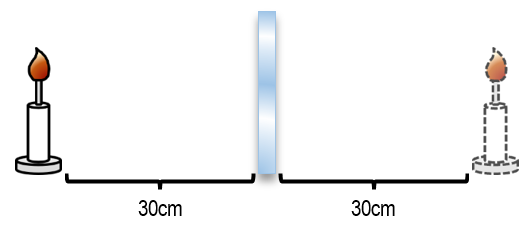
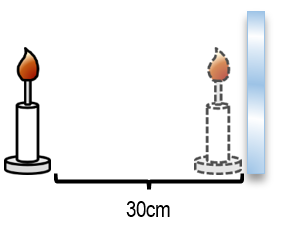
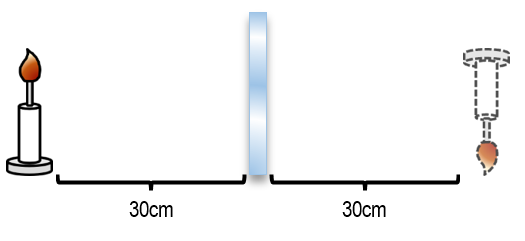
A candle is placed in front of a plane mirror. Which of the following diagrams correctly shows the image?
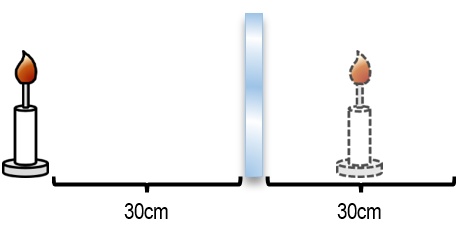
Ray Diagrams for Plane Mirrors Example 1
Here's what students ask on this topic:
In a plane mirror, the object distance () and the image distance () have equal magnitude but opposite signs. This means the image appears the same distance behind the mirror as the object is in front of it. Mathematically, this is expressed as . The negative sign indicates that the image is virtual and located behind the mirror surface. This relationship is fundamental in ray diagrams and helps us understand how virtual images are formed in plane mirrors.
Images in plane mirrors appear reversed from right to left due to the way light rays reflect off the mirror surface. When you raise your right hand, the mirror reflects the light rays such that the image appears to raise its left hand. However, the image remains upright because the vertical orientation is preserved by the reflection. This lateral inversion happens because the mirror reverses the front-back direction, making the image appear as if it is inside the mirror, but it does not flip the image vertically. This is why your reflection is upright but laterally inverted.
Ray diagrams help locate the image formed by a plane mirror by tracing light rays from the object to the mirror and then reflecting them according to the law of reflection. Typically, two or three rays are drawn from the top of the object: one ray strikes the mirror perpendicularly and reflects back on itself, and another ray strikes the mirror at an angle and reflects with the same angle. By extending the reflected rays backward behind the mirror, they appear to converge at a point where the virtual image is formed. This point is the same distance behind the mirror as the object is in front, allowing us to visualize the image's position and size.
Images formed by plane mirrors have several key properties: (1) The image is virtual, meaning it cannot be projected onto a screen and appears behind the mirror. (2) The image is upright, maintaining the same vertical orientation as the object. (3) The image is laterally inverted, reversed from right to left. (4) The size of the image is the same as the object, so the magnification () is equal to one, . (5) The image distance equals the object distance in magnitude but is located behind the mirror, expressed as . These properties are essential for understanding reflections in plane mirrors.
To calculate the distance between points on an object and its image in a plane mirror, you use the fact that the image is the same distance behind the mirror as the object is in front. For example, if a meter stick is placed 30 cm in front of the mirror, the image will appear 30 cm behind it. To find the distance between two points, such as the 50 cm mark on the object and the mirror image of the 40 cm mark, you add the distances along the line: the distance from the 50 cm mark to the mirror, the distance from the mirror to the image of the 40 cm mark, and the difference between the points on the object. This approach uses basic geometry and the relationship to find the total distance.