Obtain a bottle of aspirin and identify the amount of active ingredient (acetylsalicylic acid, C9H8O4) per tablet.How many moles of aspirin are in one tablet?
Verified step by step guidance
1
Identify the mass of acetylsalicylic acid (C9H8O4) per tablet from the bottle's label.
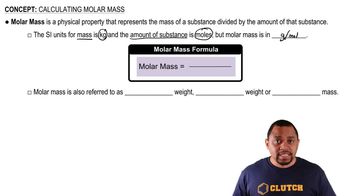
Determine the molar mass of acetylsalicylic acid by adding the atomic masses of all the atoms in the formula: C9H8O4.
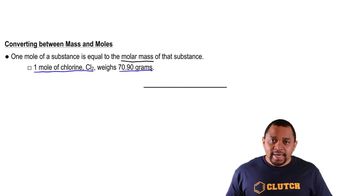
Use the formula: \( \text{moles} = \frac{\text{mass of acetylsalicylic acid per tablet}}{\text{molar mass of C9H8O4}} \) to calculate the number of moles.
Substitute the mass of acetylsalicylic acid per tablet and the molar mass of C9H8O4 into the formula.
Perform the division to find the number of moles of aspirin in one tablet.
Was this helpful?
Key Concepts
Here are the essential concepts you must grasp in order to answer the question correctly.
Molar Mass
Molar mass is the mass of one mole of a substance, typically expressed in grams per mole (g/mol). For acetylsalicylic acid (C9H8O4), the molar mass can be calculated by summing the atomic masses of its constituent elements: carbon (C), hydrogen (H), and oxygen (O). This value is essential for converting between grams and moles, allowing us to determine how many moles of aspirin are present in a given mass.
A mole is a unit in chemistry that represents a specific quantity of particles, typically atoms or molecules. One mole contains approximately 6.022 x 10^23 entities, known as Avogadro's number. Understanding moles is crucial for stoichiometric calculations, as it allows chemists to relate the mass of a substance to the number of particles, facilitating the determination of how many moles of aspirin are in a tablet based on its mass.
Concentration refers to the amount of active ingredient in a given volume or mass of a solution or solid. In the context of aspirin tablets, knowing the concentration of acetylsalicylic acid helps in determining the dosage per tablet. This information is vital for understanding the therapeutic effects and ensuring safe consumption, as it directly relates to how many moles of the active ingredient are available for pharmacological action.