Ibuprofen, an anti-inflammatory drug in Advil, has the formula C₁₃H₁₈O₂ (7.1, 7.2, 7.3) d. How many moles of ibuprofen contain 1.22 x 10²³ atoms of C?
Verified step by step guidance
1
Identify the number of carbon atoms in one molecule of ibuprofen, which is given by the formula C_{13}H_{18}O_{2}.
Use Avogadro's number (6.022 \times 10^{23} atoms/mol) to determine the number of moles of carbon atoms in 1.22 \times 10^{23} atoms of C.
Calculate the moles of carbon atoms by dividing the given number of carbon atoms (1.22 \times 10^{23}) by Avogadro's number.
Since each molecule of ibuprofen contains 13 carbon atoms, determine the moles of ibuprofen by dividing the moles of carbon atoms by 13.
Express the final answer in terms of moles of ibuprofen.
Was this helpful?
Key Concepts
Here are the essential concepts you must grasp in order to answer the question correctly.
Mole Concept
The mole is a fundamental unit in chemistry that quantifies the amount of substance. One mole contains approximately 6.022 x 10²³ entities, such as atoms or molecules. This concept allows chemists to convert between the mass of a substance and the number of particles it contains, facilitating calculations in stoichiometry.
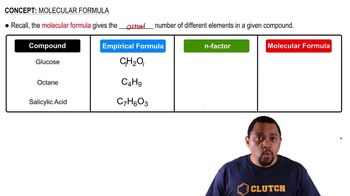
The molecular formula of a compound indicates the number and type of atoms present in a molecule. For ibuprofen, C₁₃H₁₈O₂ signifies that each molecule contains 13 carbon (C) atoms, 18 hydrogen (H) atoms, and 2 oxygen (O) atoms. Understanding the molecular formula is essential for determining the composition and performing calculations related to the substance.
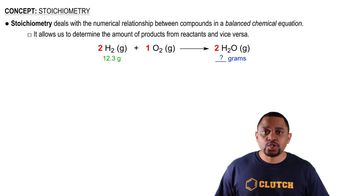
Stoichiometry is the area of chemistry that deals with the relationships between the quantities of reactants and products in chemical reactions. It allows for the calculation of moles of substances involved in a reaction based on their molecular formulas. In this case, stoichiometry helps determine how many moles of ibuprofen correspond to a specific number of carbon atoms.