Identify the chemical formula of the compound: \( K_2SO_4 \).
Determine the ions present in the compound: \( K^+ \) and \( SO_4^{2-} \).
Count the number of each type of ion in one formula unit of \( K_2SO_4 \): there are 2 \( K^+ \) ions and 1 \( SO_4^{2-} \) ion.
Calculate the total number of ions in one formula unit: 2 \( K^+ \) ions + 1 \( SO_4^{2-} \) ion = 3 ions.
Multiply the number of moles of \( K_2SO_4 \) by the total number of ions per formula unit to find the total moles of ions: \( 1.75 \text{ mol} \times 3 \text{ ions/mol} \).
Verified video answer for a similar problem:
This video solution was recommended by our tutors as helpful for the problem above.
Video duration:
2m
Play a video:
0 Comments
Key Concepts
Here are the essential concepts you must grasp in order to answer the question correctly.
Moles and Avogadro's Number
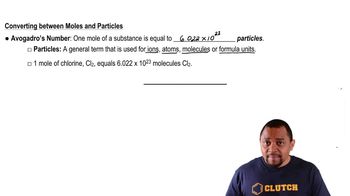
A mole is a unit in chemistry that represents 6.022 x 10^23 entities, such as atoms or molecules. This concept is fundamental for quantifying substances in chemical reactions and allows chemists to convert between grams and moles, facilitating calculations involving the amount of a substance.
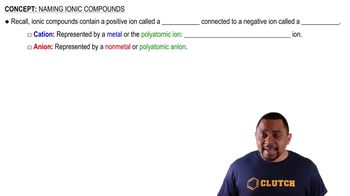
Ionic compounds, like K2SO4, dissociate into their constituent ions when dissolved in water. For K2SO4, it breaks down into 2 potassium ions (K+) and 1 sulfate ion (SO4^2-), which is essential for determining the total number of ions produced from a given amount of the compound.
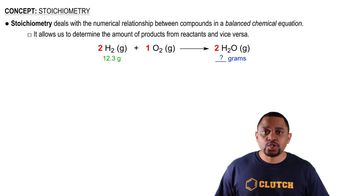
Stoichiometry is the calculation of reactants and products in chemical reactions based on the balanced chemical equation. It allows for the determination of the relationships between the amounts of substances involved, which is crucial for solving problems related to moles of ions in compounds like K2SO4.

 2:49 minutes
 Verified step by step guidance
 02:41
02:41