Table of contents
- 1. 물질과 측정
- What is Chemistry?
- The Scientific Method
- Classification of Matter
- States of Matter
- Physical & Chemical Changes
- Chemical Properties
- Physical Properties
- Intensive vs. Extensive Properties
- Temperature (Simplified)
- Scientific Notation
- SI Units (Simplified)
- Metric Prefixes
- Significant Figures (Simplified)
- Significant Figures: Precision in Measurements
- Significant Figures: In Calculations
- Conversion Factors (Simplified)
- Dimensional Analysis
- Density
- Specific Gravity
- Density of Geometric Objects
- Density of Non-Geometric Objects
- 2. 원자와 주기율표
- The Atom (Simplified)
- Subatomic Particles (Simplified)
- Isotopes
- Ions (Simplified)
- Atomic Mass (Simplified)
- Atomic Mass (Conceptual)
- Periodic Table: Element Symbols
- Periodic Table: Classifications
- Periodic Table: Group Names
- Periodic Table: Representative Elements & Transition Metals
- Periodic Table: Elemental Forms (Simplified)
- Periodic Table: Phases (Simplified)
- Law of Definite Proportions
- Atomic Theory
- Millikan Oil Drop Experiment
- Rutherford Gold Foil Experiment
- Wavelength and Frequency (Simplified)
- Electromagnetic Spectrum (Simplified)
- Bohr Model (Simplified)
- Emission Spectrum (Simplified)
- Electronic Structure
- Electronic Structure: Shells
- Electronic Structure: Subshells
- Electronic Structure: Orbitals
- Electronic Structure: Electron Spin
- Electronic Structure: Number of Electrons
- The Electron Configuration (Simplified)
- Electron Arrangements
- The Electron Configuration: Condensed
- The Electron Configuration: Exceptions (Simplified)
- Ions and the Octet Rule
- Ions and the Octet Rule (Simplified)
- Valence Electrons of Elements (Simplified)
- Lewis Dot Symbols (Simplified)
- Periodic Trend: Metallic Character
- Periodic Trend: Atomic Radius (Simplified)
- 3. 이온 화합물
- Periodic Table: Main Group Element Charges
- Periodic Table: Transition Metal Charges
- Periodic Trend: Ionic Radius (Simplified)
- Periodic Trend: Ranking Ionic Radii
- Periodic Trend: Ionization Energy (Simplified)
- Periodic Trend: Electron Affinity (Simplified)
- Ionic Bonding
- Naming Monoatomic Cations
- Naming Monoatomic Anions
- Polyatomic Ions
- Naming Ionic Compounds
- Writing Formula Units of Ionic Compounds
- Naming Ionic Hydrates
- Naming Acids
- 4. 분자 화합물
- Covalent Bonds
- Naming Binary Molecular Compounds
- Molecular Models
- Bonding Preferences
- Lewis Dot Structures: Neutral Compounds (Simplified)
- Multiple Bonds
- Multiple Bonds (Simplified)
- Lewis Dot Structures: Multiple Bonds
- Lewis Dot Structures: Ions (Simplified)
- Lewis Dot Structures: Exceptions (Simplified)
- Resonance Structures (Simplified)
- Valence Shell Electron Pair Repulsion Theory (Simplified)
- Electron Geometry (Simplified)
- Molecular Geometry (Simplified)
- Bond Angles (Simplified)
- Dipole Moment (Simplified)
- Molecular Polarity (Simplified)
- 5. 화학 반응의 분류 및 균형
- Chemical Reaction: Chemical Change
- Law of Conservation of Mass
- Balancing Chemical Equations (Simplified)
- Solubility Rules
- Molecular Equations
- Types of Chemical Reactions
- Complete Ionic Equations
- Calculate Oxidation Numbers
- Redox Reactions
- Spontaneous Redox Reactions
- Balancing Redox Reactions: Acidic Solutions
- Balancing Redox Reactions: Basic Solutions
- Balancing Redox Reactions (Simplified)
- Galvanic Cell (Simplified)
- Electrolytic Cell
- 6. 화학 반응 및 양
- 7. 에너지, 속도 및 균형
- Nature of Energy
- First Law of Thermodynamics
- Endothermic & Exothermic Reactions
- Bond Energy
- Thermochemical Equations
- Heat Capacity
- Thermal Equilibrium (Simplified)
- Hess's Law
- Rate of Reaction
- Energy Diagrams
- Rate Law (Simplified)
- Reaction Mechanism
- Chemical Equilibrium
- The Equilibrium Constant
- Le Chatelier's Principle
- Solubility Product Constant (Ksp)
- Spontaneous vs Nonspontaneous Reactions
- Entropy (Simplified)
- Gibbs Free Energy (Simplified)
- 8. 기체, 액체 및 고체
- Pressure Units
- Kinetic Molecular Theory
- The Ideal Gas Law
- The Ideal Gas Law Derivations
- The Ideal Gas Law Applications
- Chemistry Gas Laws
- Chemistry Gas Laws: Combined Gas Law
- Standard Temperature and Pressure
- Dalton's Law: Partial Pressure (Simplified)
- Gas Stoichiometry
- Van der Waals Equation
- Intermolecular Forces (Simplified)
- Intermolecular Forces and Physical Properties
- Atomic, Ionic and Molecular Solids
- Heating and Cooling Curves
- 9. 해결책
- Solutions
- Solubility and Intermolecular Forces
- Solutions: Mass Percent
- Percent Concentrations
- Molarity
- Osmolarity
- Parts per Million (ppm)
- Solubility: Temperature Effect
- Intro to Henry's Law
- Henry's Law Calculations
- Dilutions
- Solution Stoichiometry
- Electrolytes (Simplified)
- Equivalents
- Molality
- The Colligative Properties
- Boiling Point Elevation
- Freezing Point Depression
- Osmosis
- Osmotic Pressure
- Vapor Pressure Lowering (Raoult's Law)
- 10. 산과 염기
- Acid-Base Introduction
- Arrhenius Acid and Base
- Bronsted Lowry Acid and Base
- Acid and Base Strength
- Ka and Kb
- The pH Scale
- Auto-Ionization
- pH of Strong Acids and Bases
- Acid-Base Equivalents
- Acid-Base Reactions
- Gas Evolution Equations (Simplified)
- Ionic Salts (Simplified)
- Buffers
- Henderson-Hasselbalch Equation
- Strong Acid Strong Base Titrations (Simplified)
- 11. 핵화학
- 보너스: 실험실 기법 및 절차
- 보너스: 수학적 연산과 함수
- 12. 유기화학 입문
- 13. 알켄, 알킨, 방향족 화합물
- Spatial Orientation of Bonds
- Intro to Hydrocarbons
- Isomers
- Chirality
- Naming Alkenes
- Naming Dienes and Trienes
- Naming Alkynes
- Intro to Addition Reactions
- Halogenation Reaction
- Hydrogenation Reaction
- Hydrohalogenation Reaction
- Hydration Reaction
- Naming Benzene
- Benzene Reactions
- Benzene Reaction: Nitration
- Benzene Reaction: Sulfonation
- 14. 산소 또는 황을 포함한 화합물
- 15. 알데히드와 케톤
- 16. 카복실산과 그 유도체
- 17. 아민
- 18. 아미노산 및 단백질
- 19. 효소
- 20. 탄수화물
- Intro to Carbohydrates
- Classification of Carbohydrates
- Fischer Projections
- Enantiomers vs Diastereomers
- D vs L Enantiomers
- Cyclic Hemiacetals
- Intro to Haworth Projections
- Cyclic Structures of Monosaccharides
- Mutarotation
- Reduction of Monosaccharides
- Oxidation of Monosaccharides
- Glycosidic Linkage
- Disaccharides
- Polysaccharides
- 21. 생화학 에너지 생성
- 22. 탄수화물 대사
- 23. 지질
- 24. 지질 대사
- 25. 단백질 및 아미노산 대사
- 26. 핵산과 단백질 합성
- Intro to Nucleic Acids
- Nitrogenous Bases
- Nucleoside and Nucleotide Formation
- Naming Nucleosides and Nucleotides
- Phosphodiester Bond Formation
- Primary Structure of Nucleic Acids
- Base Pairing
- DNA Double Helix
- Intro to DNA Replication
- Steps of DNA Replication
- Types of RNA
- Overview of Protein Synthesis
- Transcription: mRNA Synthesis
- Processing of pre-mRNA
- The Genetic Code
- Introduction to Translation
- Translation: Protein Synthesis
- Introduction to Viruses
- Introduction to Animal Virus Infections
7. 에너지, 속도 및 균형
Heat Capacity
7. 에너지, 속도 및 균형
Heat Capacity
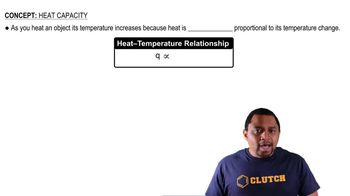
 00:31


Practice this topic
- Multiple Choice
A sample of copper absorbs 3.53 kJ of heat, which increases the temperature by 25 ºC, determine the mass (in kg) of the copper sample if the specific heat capacity of copper is 0.385 J / g ºC.
6533views22rank - Multiple Choice
Based on their given specific heat capacities which compound would show the greatest temperature change upon absorbing 25.0 J of heat?
6299views17rank - Multiple Choice
50.00 g of heated metal ore is placed into an insulated beaker containing 822.5 g of water. Once the metal heats up the final temperature of the water is 32.08 ºC. If the metal gains 14.55 kJ of energy, what is the initial temperature of the water?
5302views31rank1comments