Which of the following metabolic processes can occur without a net influx of energy from some other process?
a. ⓅADP+Ⓟi→ATP+H2O
b. C6H12O6+6O2→6CO2+6H2O
c. 6CO2+6H2O→C6H12O6+6O2
d. Aminoacids→Protein
Verified step by step guidance
1
Identify the type of metabolic processes listed in the options: a) ATP synthesis, b) Cellular respiration, c) Photosynthesis, d) Protein synthesis.
Recall that processes that release energy are exergonic, while those that require energy input are endergonic.
Consider that cellular respiration (option b) is a catabolic process that breaks down glucose and releases energy, making it exergonic.
Recognize that ATP synthesis (option a), photosynthesis (option c), and protein synthesis (option d) are anabolic processes that require energy input, making them endergonic.
Conclude that the process which can occur without a net influx of energy from another process is the exergonic process, which is cellular respiration (option b).
Verified video answer for a similar problem:
This video solution was recommended by our tutors as helpful for the problem above.
Video duration:
45s
Play a video:
0 Comments
Key Concepts
Here are the essential concepts you must grasp in order to answer the question correctly.
Metabolic Processes
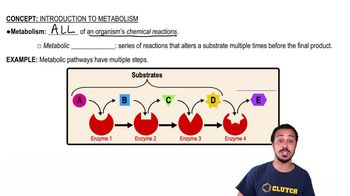
Metabolic processes refer to the biochemical reactions that occur within living organisms to maintain life. These processes can be categorized into catabolism, which breaks down molecules to release energy, and anabolism, which builds complex molecules from simpler ones. Understanding these processes is crucial for determining how energy is utilized or conserved in biological systems.
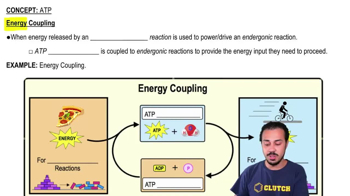
Energy coupling is the mechanism by which energy released from exergonic reactions (which release energy) is used to drive endergonic reactions (which require energy). This concept is essential for understanding how cells manage energy flow, allowing them to perform work without a net influx of energy from external sources. It highlights the interconnectedness of various metabolic pathways.
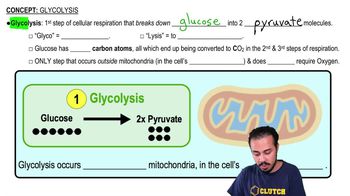
Glycolysis is the metabolic pathway that converts glucose into pyruvate, producing a small amount of ATP in the process. Cellular respiration encompasses the complete oxidation of glucose to carbon dioxide and water, releasing energy. Recognizing these pathways helps in identifying which metabolic processes can occur spontaneously and which require energy input, thus answering the question effectively.

 0:45 minutes
 Verified step by step guidance
 02:17
02:17