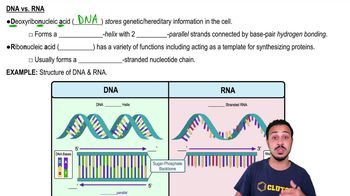
What are the four nitrogenous bases found in RNA?
a. cytosine, guanine, thymine, uracil (C, G, T, U)
b. adenine, cytosine, guanine, thymine (A, C, G, T)
c. adenine, cytosine, guanine, uracil (A, C, G, U)
d. alanine, cysteine, glycine, threonine (A, C, G, T)
Verified step by step guidance
1
Identify that the question is asking for the nitrogenous bases specific to RNA.
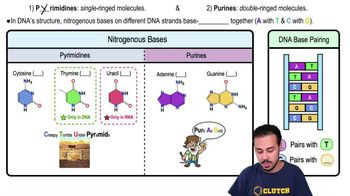
Recall that RNA and DNA share three common nitrogenous bases: adenine (A), cytosine (C), and guanine (G).
Remember that RNA contains uracil (U) instead of thymine (T), which is found in DNA.
Eliminate any options that include thymine (T) or any non-nitrogenous bases such as amino acids (alanine, cysteine, glycine, threonine).
Select the option that includes adenine, cytosine, guanine, and uracil as the four nitrogenous bases in RNA.
Verified video answer for a similar problem:
This video solution was recommended by our tutors as helpful for the problem above.
Video duration:
59s
Play a video:
0 Comments
Key Concepts
Here are the essential concepts you must grasp in order to answer the question correctly.
Nitrogenous Bases
Nitrogenous bases are organic molecules that contain nitrogen and are fundamental components of nucleic acids like DNA and RNA. In RNA, the four bases are adenine (A), cytosine (C), guanine (G), and uracil (U). These bases pair with each other to form the genetic code, with adenine pairing with uracil in RNA, unlike DNA where adenine pairs with thymine.
RNA, or ribonucleic acid, is a single-stranded molecule that plays a crucial role in coding, decoding, regulation, and expression of genes. Its structure includes a ribose sugar, a phosphate group, and nitrogenous bases. The presence of uracil instead of thymine distinguishes RNA from DNA, influencing its function in protein synthesis and other cellular processes.
Base pairing rules dictate how nitrogenous bases interact in nucleic acids. In RNA, adenine pairs with uracil, while cytosine pairs with guanine. Understanding these pairing rules is essential for grasping how genetic information is transcribed and translated, as they ensure the correct sequence of amino acids in proteins, which are vital for cellular function.

 0:59 minutes
 Verified step by step guidance
 07:21
07:21