Ch. 4 Histology
Amerman - Human Anatomy & Physiology 2nd Edition
Amerman2nd EditionHuman Anatomy & PhysiologyISBN: 9780136873822Not the one you use?Change textbook
Chapter 4, Problem L3.B6

Explain why it would be difficult for a mature multinucleate cell such as a skeletal muscle fiber to divide by mitosis.

Verified step by step guidance
1
Understand the structure of a skeletal muscle fiber: Skeletal muscle fibers are long, cylindrical cells that are multinucleate, meaning they contain multiple nuclei within a single cell. This unique structure arises from the fusion of myoblasts during development.
Review the process of mitosis: Mitosis is the division of a single nucleus into two identical nuclei, followed by cytokinesis, which divides the cytoplasm to form two separate daughter cells. This process is typically seen in cells with a single nucleus.
Consider the challenges posed by multinucleation: In a multinucleate cell like a skeletal muscle fiber, mitosis would require the coordination of multiple nuclei dividing simultaneously. This is highly complex and not typically observed in such cells.
Examine the size and structure of skeletal muscle fibers: Skeletal muscle fibers are extremely large compared to most other cells, and their specialized structure (including the arrangement of contractile proteins) is not conducive to the physical division required in mitosis.
Conclude why mitosis is unlikely: Due to the multinucleate nature, size, and specialized function of skeletal muscle fibers, they are not designed to divide by mitosis. Instead, muscle growth and repair occur through other mechanisms, such as satellite cell activation and fusion with existing fibers.

Verified video answer for a similar problem:

This video solution was recommended by our tutors as helpful for the problem above.
Was this helpful?

Key Concepts

Here are the essential concepts you must grasp in order to answer the question correctly.

Multinucleate Cells

Multinucleate cells, such as skeletal muscle fibers, contain multiple nuclei within a single cell membrane. This structure arises from the fusion of precursor cells during development, allowing for greater control over cellular functions and protein synthesis. However, the presence of multiple nuclei complicates the process of mitosis, as each nucleus must coordinate its division, which can lead to challenges in evenly distributing genetic material.
Recommended video:
05:33
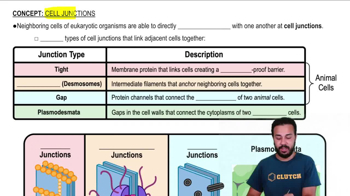
Cell Junctions

Mitosis

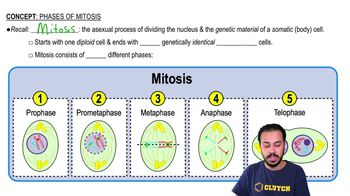
Mitosis is the process of cell division that results in two genetically identical daughter cells from a single parent cell. It involves several stages: prophase, metaphase, anaphase, and telophase, where chromosomes are duplicated and separated. In multinucleate cells, the coordination required for mitosis becomes complex, as each nucleus must replicate its DNA and divide simultaneously, which is difficult to achieve without disrupting cellular integrity.
Recommended video:
03:21
Phases of Mitosis

Cell Cycle Regulation

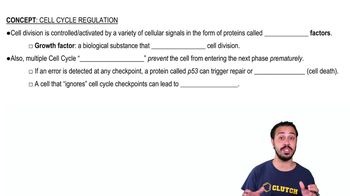
The cell cycle is tightly regulated by various checkpoints and proteins that ensure proper cell division and function. In multinucleate cells, the regulation of the cell cycle can be more challenging due to the presence of multiple nuclei, which may not all respond uniformly to regulatory signals. This lack of coordination can hinder the cell's ability to undergo mitosis effectively, leading to potential issues such as unequal distribution of genetic material and cellular dysfunction.
Recommended video:
03:31
Cell Cycle Regulation